Best Pimax VR Headsets: 9 Models Compared
As an Amazon Associate we earn from qualifying purchases. Links on this page are affiliate links.
Finding the best Pimax VR headsets requires matching specific display specs to your simulation rig. This guide compares 9 models based strictly on published specifications. The Pimax Crystal Super Ultrawide VR Headset leads the list because its 140-degree field of view suits flight simulation setups needing wide peripheral vision. Other options include QLED and Micro-OLED panels with varying resolutions and pixel densities. You will find lightweight QLED choices for budget builds or high-density Micro-OLED units for seated cockpit gaming. Each pick addresses distinct clarity and tracking needs defined by the product data.
Quick picks
Our 9 picks

Pimax Crystal Super Ultrawide VR Headset
Best for: flight simulation setups needing wide peripheral vision
- Display Resolution
- 3840x3840 per eye
- Refresh Rate
- 90Hz
- Field of View
- 140°
- Display Type
- QLED & Mini-LED
- Tracking Type
- Inside-Out
- Color
- Black
This PC VR headset delivers 3840x3840 resolution per eye through QLED and Mini-LED displays with local dimming. You get an expansive 140-degree field of view paired with 50 pixels per degree via aspherical lenses. It features inside-out tracking, integrated 3D spatial audio, and refresh rates up to 90Hz. It suits simulator enthusiasts prioritizing wide peripheral visibility.
Pros
- Dual 3840x3840 displays with Mini-LED local dimming
- Expansive 140-degree field of view for peripheral vision
- 50 pixels per degree angular resolution with aspherical lenses
- Integrated inside-out tracking and spatial audio
Cons
- Lower 50 PPD acuity compared to 57 PPD alternatives on the line
- Package lists no included handheld controllers
Good fit if
- You need a 140-degree field of view for situational awareness in simulators.
- You run a PC setup capable of driving dual 3840x3840 displays at 90Hz.
Skip if
- You want higher pixel density above 50 PPD for fine instrument reading.
- You need included motion controllers in the box for standalone VR titles.
Verdict: Pimax Crystal Super 140° FOV VR Headset suits flight and racing simulator pilots who require wide peripheral tracking alongside 3840x3840 resolution.
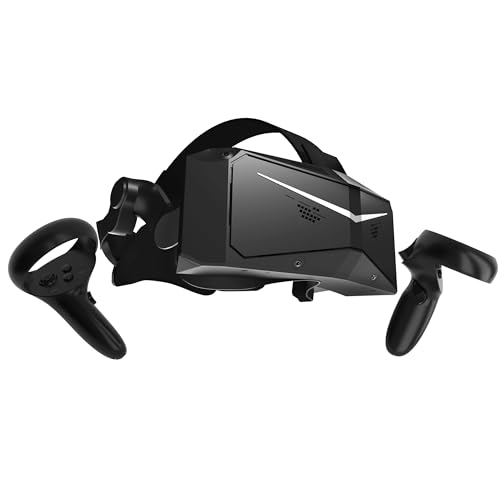
Pimax Crystal Light VR Headset
Best for: PC flight and racing simulation gaming
- Display Resolution
- 2880×2880 per eye
- Refresh Rate
- 72Hz/90Hz/120Hz
- Display Type
- QLED
- Tracking Type
- Inside-Out, Base Station
- Color
- Black
- Platform
- PC
The Pimax Crystal Light is a tethered PC VR headset built for simulation gaming. You get 2880x2880 resolution per eye, a 35 PPD rating, and a QLED panel featuring local dimming. It operates at refresh rates of 72Hz, 90Hz, or 120Hz. At 1.8 pounds, this model suits flight and racing sim pilots seeking sharp cockpit details.
Pros
- 2880x2880 resolution per eye with 35 PPD clarity
- Selectable 72Hz, 90Hz, and 120Hz refresh rates
- QLED display paired with local dimming for contrast
- Includes controllers and inside-out camera tracking
Cons
- Resolution is lower than the 3840x3840 per eye on Super models
- Pixel density of 35 PPD trails the 53 and 57 PPD alternatives
Good fit if
- You run flight or racing simulators on a dedicated PC setup.
- You need selectable refresh rates between 72Hz and 120Hz.
- You prefer out-of-the-box inside-out camera tracking.
Skip if
- You require 3840x3840 resolution per eye.
- You want a 53 PPD or 57 PPD display profile.
Verdict: Pimax Crystal Light QLED VR Headset provides 2880x2880 clarity and local dimming for PC simulation players who want readable instruments without stepping up to larger Super series hardware.
Pimax Crystal Light QLED VR Headset
Best for: PC sim racers using existing SteamVR controllers
- Display Resolution
- 2880x2880 per eye
- Refresh Rate
- 120Hz
- Display Type
- QLED
- Tracking Type
- Inside-Out
- Color
- Black
- Platform
- PC
This PC-tethered headset delivers 2880x2880 resolution per eye across a QLED panel equipped with local dimming. It features inside-out camera tracking, glass aspheric lenses, and refresh rates up to 120Hz. If you already own compatible SteamVR controllers and want high visual fidelity without base stations, this model gives you sharp simulation visuals at an 815-gram total weight.
Pros
- 2880x2880 resolution per eye on a QLED panel with local dimming
- Refresh rate reaches up to 120Hz for low-latency motion
- Glass aspheric lenses provide edge-to-edge clarity
- Built-in inside-out camera tracking requires no external sensors
Cons
- Lower 2880x2880 per-eye resolution than 3840x3840 Crystal Super models
- Package does not include VR controllers
- Relies on fixed foveated rendering rather than eye tracking
Good fit if
- You want inside-out camera tracking without mounting external base stations.
- You need high-clarity 2880x2880 per-eye panels running at up to 120Hz.
- You already own compatible controllers such as Valve Index Knuckles.
Skip if
- You want the higher 3840x3840 per-eye resolution of the Crystal Super line.
- You require an all-in-one package that includes controllers in the box.
Verdict: Pimax Crystal Light QLED PC VR Headset suits PC flight and racing simulator pilots who want 2880x2880 clarity and inside-out tracking with their existing peripherals.

Pimax Crystal Super 57 PPD VR Headset
Best for: seated simulator pilots seeking high pixel density
- Display Resolution
- 3840x3840 per eye
- Refresh Rate
- 72Hz, 90Hz
- Field of View
- 127°
The Pimax Crystal Super delivers 3840x3840 resolution per eye alongside a clarity rating of 57 PPD. This package includes a Studioform face pad kit and uses glass aspheric lenses. It offers variable refresh rates of 72Hz and 90Hz. If you prioritize high pixel density and cushioned face padding for PC simulators, this configuration suits you.
Pros
- 3840 x 3840 resolution per eye
- 57 PPD with 127° horizontal field of view
- Glass aspheric lenses with a large sweet spot
- Includes tailored Studioform face pad kit
- Variable refresh rate supporting 72Hz and 90Hz
Cons
- Top refresh rate is 90Hz
- Controllers are not listed in the product data
Good fit if
- You want 3840x3840 resolution per eye for sharp image clarity.
- You want an included Studioform face pad kit for custom comfort.
- You play PC titles that target 72Hz or 90Hz refresh rates.
Skip if
- You require refresh rates higher than 90Hz.
- You need included handheld VR controllers.
Verdict: Pimax Crystal Super with Studioform Face Pad fits simulation pilots and drivers who demand 57 PPD clarity and extra face padding. Its 90Hz ceiling and omission of bundled controllers focus it squarely on seated sim rigs.

Pimax Crystal Super Micro-OLED VR Headset
Best for: Micro-OLED clarity and high-density simulation gaming
- Display Resolution
- 3840x3552 Per Eye
- Refresh Rate
- 90Hz
- Field of View
- 116°
- Display Type
- Micro-OLED
- Tracking Type
- 6DOF spatial tracking
This PC headset features twin Micro-OLED panels delivering 3840x3552 resolution per eye and 53 PPD clarity. It offers a 116-degree horizontal field of view, 6DOF spatial tracking, and a 90Hz refresh rate. You also receive a Studioform face cushion cover kit in the bundle. It suits you if you prioritize deep Micro-OLED contrast and high pixel density over maximum field of view.
Pros
- Micro-OLED display with 3840x3552 resolution per eye
- 53 PPD high pixel density
- Sub-millimeter 6DOF spatial tracking precision
- Includes Studioform face cushion kit
Cons
- 116-degree horizontal field of view is narrower than 140-degree Pimax models
- Controllers are not listed as included in the bundle
- Display refresh rate is limited to 90Hz
Good fit if
- You want high-density Micro-OLED visual fidelity with 53 PPD.
- You need sub-millimeter 6DOF spatial tracking.
- You already own compatible controllers for your PC VR setup.
Skip if
- You want an ultrawide 140-degree field of view.
- You need a bundle that includes hand controllers.
Verdict: Pimax Crystal Super Micro-OLED VR Headset delivers ultra-sharp 3840x3552 Micro-OLED panels and 53 PPD for simulation enthusiasts focused on visual clarity. It is built for users who value high pixel density over an ultrawide field of view or bundled controllers.

Pimax Crystal Light PC VR Headset
Best for: PC flight and racing simulation setups
- Display Resolution
- 2880×2880 per eye
- Refresh Rate
- 72Hz/90Hz/120Hz
- Field of View
- Large FOV
- Display Type
- QLED
- Tracking Type
- Inside-Out, Lighthouse
- Color
- Black
This PC-tethered headset delivers 2880×2880 resolution per eye and 35 PPD using QLED panels with local dimming. It weighs 1.8 pounds and supports 72Hz, 90Hz, and 120Hz refresh rates. It includes controllers and uses inside-out tracking with optional base-station expansion. It suits simulation pilots and PC VR players who want sharp clarity without extra bulk.
Pros
- 2880×2880 per-eye resolution with 35 PPD
- Selectable refresh rates of 72Hz, 90Hz, and 120Hz
- QLED display with local dimming for contrast
- Inside-out tracking with lighthouse expansion option
Cons
- Lower 2880×2880 resolution than the 3840×3840 Super models
- Lower pixel density than the 53 to 57 PPD on Super variants
Good fit if
- You play seated flight or racing simulators on PC.
- You want 120Hz refresh rate options alongside inside-out tracking.
Skip if
- You want the 3840×3840 resolution of the Super series.
- You need a standalone headset that operates without a PC.
Verdict: Pimax Crystal Light with Controllers delivers high-density QLED visuals and flexible refresh rates for PC simulation pilots who do not need the higher resolution of the Super series.

Pimax Crystal Super Ultrawide QLED VR Headset
Best for: high-resolution PCVR simulation without external base stations
- Display Resolution
- 3840x3840
- Display Type
- QLED + Mini LED
- Tracking Type
- Inside-Out
- Color
- Black
- Dimensions
- 14.9 × 12.2 × 7.87 inches
View on Amazon: Pimax Crystal Super Ultrawide QLED VR Headset
This PCVR package pairs a QLED and Mini LED display with two included controllers. You get 3840x3840 resolution per eye, 50 PPD clarity, and 6 DoF inside-out tracking. It features automatic IPD adjustments from 58 to 72 mm alongside Dynamic 2.0 foveated rendering. It suits dedicated PC gamers seeking high-resolution visual clarity with inside-out tracking.
Pros
- 3840x3840 resolution per eye with QLED and Mini LED panels
- 6 DoF inside-out tracking without external sensors
- Automatic IPD adjustment range of 58 mm to 72 mm
- Dynamic 2.0 foveated rendering support
Cons
- 50 PPD density is lower than the 53 and 57 PPD Super variants
- Substantial physical dimensions at 14.5 by 12 by 7.5 inches
Good fit if
- You want 3840x3840 per-eye resolution without setting up external base stations.
- You need motorized automatic IPD adjustment between 58 and 72 mm.
- You plan to use Dynamic 2.0 foveated rendering on supported PCVR titles.
Skip if
- You want maximum pixel density, as other Crystal Super editions reach 57 PPD.
- You need a compact, low-profile headset chassis.
Verdict: Pimax Crystal Super Ultrawide QLED VR Headset delivers 3840x3840 per-eye clarity and built-in inside-out tracking for PCVR enthusiasts who want wide-format visuals without mounting external tracking beacons.

Pimax Crystal Super Micro-OLED VR Headset
Best for: Micro-OLED simulation setups requiring extra facial padding
- Display Resolution
- 3840 × 3552 pixels per eye
- Refresh Rate
- 90Hz
- Field of View
- 116°
- Display Type
- Micro-OLED
This Pimax Crystal Super bundle pairs a Micro-OLED VR headset with an added Studioform face pad kit. You get a sharp 3840 × 3552 per-eye resolution, 53 PPD clarity, and a 116-degree horizontal field of view operating at 90Hz. It suits you if you want high-density OLED visual contrast and enhanced facial padding for seated PC simulation setups.
Pros
- 3840 × 3552 resolution per eye
- Micro-OLED display panels with 53 PPD clarity
- Sub-millimeter 6DOF spatial tracking
- Includes Studioform VR face pad cushion kit
Cons
- Narrower 116-degree horizontal field of view than 140-degree variants
- Package does not list included controllers
- Refresh rate caps at 90Hz
Good fit if
- You want Micro-OLED panels delivering 3840 × 3552 per-eye resolution.
- You prioritize facial comfort accessories alongside high 53 PPD density.
Skip if
- You need the wider 140-degree field of view available on other Super models.
- You require bundled hand controllers out of the box.
Verdict: Pimax Crystal Super Micro-OLED VR Headset delivers deep black levels and bundled comfort padding for dedicated flight and racing simulator enthusiasts. Its 116-degree horizontal field of view and 90Hz display target precision seated PC virtual reality cockpits.

Pimax Crystal Super 57 PPD VR Headset
Best for: high-clarity PC simulation and cockpit gaming
- Display Resolution
- 3840x3840 per eye
- Refresh Rate
- 72Hz and 90Hz
- Field of View
- 106°
- Display Type
- QLED+MiniLED
- Tracking Type
- Lighthouse Solution Limited
- Color
- Black
This PC VR headset delivers 3840x3840 pixels per eye across a QLED and Mini-LED display with local dimming. You get a 57 PPD pixel density, a 106-degree horizontal field of view, and refresh rates of 72Hz or 90Hz. It features eye tracking and automatic IPD adjustment from 58 to 72 millimeters, fitting simulator users focused on visual clarity.
Pros
- 3840x3840 per-eye resolution with 57 PPD
- QLED and Mini-LED panels with local dimming
- Automatic IPD adjustment from 58mm to 72mm
- Built-in eye tracking hardware
Cons
- Maximum refresh rate caps at 90Hz
- 106-degree horizontal field of view is narrower than ultrawide models
- Controllers are not listed as included
Good fit if
- You want high-density 57 PPD clarity for detailed PC VR simulations.
- You need motorized IPD adjustment between 58mm and 72mm.
- You utilize eye tracking for supported PC VR software.
Skip if
- You want refresh rates higher than 90Hz.
- You prefer an ultrawide field of view beyond 106 degrees.
Verdict: Pimax Crystal Super 57 PPD VR Headset delivers 3840x3840 clarity per eye for PC simulator pilots who prioritize sharpness over maximum field of view.
Specifications side by side
| Spec | Pimax Crystal Super Ultrawide VR Headset | Pimax Crystal Light VR Headset | Pimax Crystal Light QLED VR Headset | Pimax Crystal Super 57 PPD VR Headset | Pimax Crystal Super Micro-OLED VR Headset | Pimax Crystal Light PC VR Headset | Pimax Crystal Super Ultrawide QLED VR Headset | Pimax Crystal Super Micro-OLED VR Headset | Pimax Crystal Super 57 PPD VR Headset |
|---|---|---|---|---|---|---|---|---|---|
| Display Resolution | 3840x3840 per eye | 2880×2880 per eye | 2880x2880 per eye | 3840x3840 per eye | 3840x3552 Per Eye | 2880×2880 per eye | 3840x3840 | 3840 × 3552 pixels per eye | 3840x3840 per eye |
| Refresh Rate | 90Hz | 72Hz/90Hz/120Hz | 120Hz | 72Hz, 90Hz | 90Hz | 72Hz/90Hz/120Hz | not specified | 90Hz | 72Hz and 90Hz |
| Field of View | 140° | not specified | not specified | 127° | 116° | Large FOV | not specified | 116° | 106° |
| Display Type | QLED & Mini-LED | QLED | QLED | not specified | Micro-OLED | QLED | QLED + Mini LED | Micro-OLED | QLED+MiniLED |
| Tracking Type | Inside-Out | Inside-Out, Base Station | Inside-Out | not specified | 6DOF spatial tracking | Inside-Out, Lighthouse | Inside-Out | not specified | Lighthouse Solution Limited |
| Color | Black | Black | Black | not specified | C10L | Black | Black | not specified | Black |
| Platform | PC | PC | PC | not specified | not specified | PC | not specified | not specified | not specified |
| Dimensions | not specified | 15 × 12.5 × 6.7 inches | not specified | not specified | not specified | 14.6 × 11.9 × 7.7 inches | 14.9 × 12.2 × 7.87 inches | not specified | 15 × 12.3 × 8 inches |
| Weight | not specified | 1.8 pounds | 1.8 pounds | not specified | not specified | 1.8 pounds | not specified | not specified | 1.8 pounds |
| Model | Full Payment version- Ultrawide | Crystal Light Full Payment Version | Full Payment Version | not specified | not specified | Partial Payment Version | C10-Ultrawide | not specified | Full Payment Version |
| Size | not specified | 14.17 | not specified | not specified | not specified | 7.70 | 7.87 | not specified | not specified |
Pimax VR Headset Lineup Overview
Pimax headsets split into distinct groups based on display technology and resolution. The Crystal Super line targets users needing high pixel density, offering up to 3840x3840 clarity per eye. These models suit seated simulator pilots who prioritize sharpness and visual fidelity over a wide field of view. The Crystal Light series provides 2880x2880 resolution with QLED panels, making it a practical choice for budget-conscious gamers who want readable instruments without stepping up to larger hardware.
Some models feature Micro-OLED panels for deep black levels and ultra-sharp detail, while others include bundled controllers or inside-out tracking. You should choose based on whether you need ultrawide peripheral vision or compact, lightweight design. Each variant targets specific cockpit setups, ensuring you match the hardware to your simulation needs.
Where Pimax Fits Your Setup
Pimax ranges from lighter Crystal Light units at 1.8 pounds to heavier Super models. You choose between QLED panels for bright, readable instruments or Micro-OLED for deep blacks and ultra-sharp detail. Resolutions span 2880x2880 up to 3840x3840 per eye. Field of view varies from standard 116 degrees to ultrawide 140 degrees. Refresh rates cap at 90Hz. You must check if controllers are included, as some bundles omit them. All listed models run on PC. You will not find standalone or console options here. The lineup focuses on high-fidelity seated simulation rather than mixed reality or wireless freedom.
To power these high-resolution displays, you can compare compatible PC specifications across the best gaming desktops for VR.
How to Choose the Right Pimax VR Headset
-
Match Field of View to Simulation
Your simulation genre dictates the necessary field of view. Flight and racing pilots benefit from ultrawide views that enhance peripheral tracking and immersion. The Pimax Crystal Super Ultrawide VR Headset offers a 140-degree field of view, making it ideal for these setups. If you prefer a seated cockpit experience without the wide angle, other models provide standard views. Check the specifications to ensure the headset aligns with your specific needs for visual range and tracking accuracy.
-
Select Display Technology for Clarity
Display technology significantly impacts visual quality in simulation games. QLED panels provide bright, readable instruments, which is crucial for checking gauges in flight sims. The Pimax Crystal Light QLED VR Headset delivers 2880x2880 clarity with local dimming for this purpose. Alternatively, Micro-OLED panels offer deeper blacks and ultra-sharp detail, as seen in the Pimax Crystal Super Micro-OLED VR Headset. Choose QLED for brightness or Micro-OLED for contrast and pixel density based on your visual preferences.
-
Prioritize Resolution for Instrument Reading
Higher resolution reduces the screen door effect and improves text readability. The Pimax Crystal Super Ultrawide VR Headset provides 3840x3840 resolution per eye, which is excellent for sharp instrument clusters. The Pimax Crystal Light series offers 2880x2880, a step down but still clear for most users. If you sit close to the screen or rely on small text, aim for the higher resolution models. Verify the per-eye resolution in the specs to ensure you get the clarity required for detailed cockpit environments.
-
Consider Weight for Comfort
Weight affects long-term comfort during extended simulation sessions. Most models in this lineup weigh 1.8 pounds, balancing durability with wearability. The Pimax Crystal Light VR Headset and its variants maintain this weight while offering different features. Heavier models may cause neck strain over time, so check the weight specification carefully. If you plan to use the headset for hours, lighter options or those with better padding distribution, like the Studioform Face Pad, can reduce fatigue significantly.
-
Check Tracking and Controller Needs
Some headsets include controllers, while others require separate purchases. The Pimax Crystal Light with Controllers bundle provides everything needed for immediate use. Other models, like the Pimax Crystal Super 57 PPD VR Headset, omit bundled controllers to focus on hardware specs. If you already own SteamVR controllers, you can save by choosing a headset without them. Verify the included accessories in the product details to avoid unexpected additional purchases for tracking and input.
Frequently asked questions
Which Pimax VR headset offers the widest field of view?
The Pimax Crystal Super Ultrawide VR Headset provides a 140-degree field of view. This wide angle suits flight and racing simulator pilots who need extensive peripheral tracking. It pairs this view with 3840x3840 resolution per eye. You get clear visuals across a broad horizon without needing external tracking beacons.
What is the lightest Pimax VR headset available?
The Pimax Crystal Light models weigh 1.8 pounds. This includes the Crystal Light VR Headset and the Crystal Light QLED VR Headset. Both offer 2880x2880 resolution. The lighter weight makes them comfortable for longer PC simulation sessions. You get readable instrument clarity without the bulk of the heavier Super series units.
Does Pimax offer VR headsets with Micro-OLED displays?
Yes, the Pimax Crystal Super Micro-OLED VR Headsets use Micro-OLED panels. These models deliver 3840x3552 resolution and 53 PPD for ultra-sharp detail. They provide deep black levels ideal for simulation enthusiasts focused on visual clarity. These units target users who prioritize high pixel density over ultrawide fields of view.
Which Pimax headset includes bundled controllers?
The Pimax Crystal Light with Controllers includes bundled controllers. This model delivers high-density QLED visuals and flexible refresh rates for PC simulation pilots. Other models, like the Crystal Super 57 PPD, omit bundled controllers to focus on seated sim rigs. You should check the specific model name to confirm if controllers are included.
What resolution does the Pimax Crystal Super Ultrawide provide?
The Pimax Crystal Super Ultrawide VR Headset offers 3840x3840 resolution per eye. This high clarity suits PCVR enthusiasts who want wide-format visuals. It features built-in inside-out tracking, so you do not need external base stations. The 140-degree field of view enhances immersion for flight and racing simulations.
Which Pimax headset is best for seated simulator pilots?
The Pimax Crystal Super 57 PPD VR Headset fits seated simulator pilots seeking high pixel density. It offers 57 PPD clarity and extra face padding. Its 90Hz refresh rate and omission of bundled controllers focus it on seated rigs. The Pimax Crystal Super Micro-OLED VR Headset also targets precision seated PC virtual reality cockpits.
How many Pimax VR headsets are compared here?
This guide compares 9 Pimax VR headsets. The list includes models from the Crystal Light and Crystal Super lines. You can choose between QLED panels for bright instruments or Micro-OLED for sharp detail. Resolutions range from 2880x2880 to 3840x3840 per eye. Fields of view vary to suit different simulation needs.