XREAL One Pro AR Glasses vs XREAL 1S Beam Pro WiFi: Spec Comparison
As an Amazon Associate we earn from qualifying purchases. Links on this page are affiliate links.
Comparing xreal one pro ar glasses vs 1s beam pro wifi reveals two distinct approaches to spatial computing. Both use Sony Micro-OLED displays with 120Hz refresh rates and Bose-tuned audio. The main difference lies in their architecture. The One Pro is a standalone headset with an X1 chip. The 1S bundle pairs glasses with a separate Beam Pro device running Android 14. This changes how you interact with apps and content.
Key differences
| Aspect | XREAL One Pro AR Glasses 120Hz | XREAL 1S & Beam Pro WiFi Bundle |
|---|---|---|
| Operating System | Not listed (requires external device) | Android 14 |
| RAM and Storage | Not listed | 8GB RAM, 256GB Storage |
| Display Resolution | 1080p | 1920x1200 |
| Lighting Control | Anti-glare design | Electrochromic lenses |
| Chipset | X1 Spatial Computing Chip | X1 Spatial Computing Chip |
Which one should you choose?
Choose XREAL One Pro AR Glasses 120Hz if
- You prefer a lightweight, self-contained headset without needing a separate computing unit.
- You want to connect to any USB-C device like a Steam Deck or laptop.
- You need adjustable IPD sizes for a better fit.
Choose XREAL 1S & Beam Pro WiFi Bundle if
- You want to run native Android apps directly via the Beam Pro.
- You prefer a higher resolution display at 1920x1200.
- You want automatic light adjustment with electrochromic lenses.
Verdict: The One Pro suits you if you want a simple, standalone display for existing devices. The 1S Beam Pro bundle is better if you want an all-in-one Android experience with higher resolution and built-in storage.
Specs: Chip, RAM, OS, and Display
Processing power
The XREAL One Pro AR Glasses rely on the self-developed X1 Spatial Computing Chip. This component handles native 3DoF tracking with ultra-low 3ms M2P latency. It ensures stable visuals during rapid movements. When paired with the optional XREAL Eye, it supports full 6DoF spatial anchoring. The XREAL 1S and Beam Pro WiFi Bundle also uses XREAL’s proprietary X1 spatial computing chip. This chip delivers the same 3ms M2P latency for smooth 3DoF and 6DoF displays. Both products share the same core processing engine for spatial tracking. This creates a tie in raw tracking performance and latency characteristics.
RAM and storage
The XREAL One Pro AR Glasses do not list internal RAM or storage capacity in the provided data. It functions primarily as a display device compatible with various external devices. In contrast, the XREAL 1S and Beam Pro WiFi Bundle includes significant internal resources. The Beam Pro component features 8GB of RAM and 256GB of storage. This allows the bundle to run Android 14 natively and support Google Play Store apps independently. The 1S display itself does not list these specs, but the bundle’s computing unit provides substantial local power. This gives the bundle a clear advantage for standalone operation.
Operating system
The XREAL One Pro AR Glasses do not specify an operating system. They act as a display for external sources like USB-C devices, Steam Deck, or PCs. The XREAL 1S and Beam Pro WiFi Bundle runs Android 14. This native OS allows the Beam Pro to function as a portable spatial computer. It provides full access to the Google Play Store. You can run millions of native Android apps rendered as spatial windows. This enables cloud gaming and multitasking without needing an external device. The bundle offers a complete software ecosystem, while the One Pro remains a passive display.
Screen resolution
The XREAL One Pro AR Glasses feature a 1080p screen resolution. This is paired with a 120Hz refresh rate and Sony Micro-OLED technology. The XREAL 1S also uses Sony Micro-OLED displays with a 120Hz refresh rate. However, the 1S offers a higher resolution of 1920x1200. This provides sharper image clarity compared to the 1080p output of the One Pro. Both use the same display panel technology and refresh rate for smooth motion. The difference lies solely in the pixel density and resolution. The higher resolution of the 1S bundle gives it an edge in visual sharpness.
Field of view
Both products offer a 57° field of view. The XREAL One Pro AR Glasses use Optic Engine 4.0 to recreate a 171-inch virtual screen from four meters away. The XREAL 1S and Beam Pro WiFi Bundle also projects a virtual screen up to 171 inches. Both utilize advanced optics to minimize reflections and enhance clarity. The field of view specification is identical for both devices. This means the immersive size and peripheral coverage are the same. Neither product has an advantage in terms of the viewing angle or virtual screen size.
Choose based on your app needs
Users wanting native Android apps
The XREAL 1S and Beam Pro WiFi bundle includes a built-in Android 14 operating system. This allows direct access to the Google Play Store. You can run millions of native Android apps as spatial windows. The 8GB RAM and 256GB storage handle multitasking. This setup offers a complete, all-in-one spatial computing ecosystem without needing an external device.
Users preferring device versatility
The XREAL One Pro AR Glasses connect to any USB-C device with video output. This includes Steam Deck, ROG Ally, MacBook, Windows PCs, and Android phones. It acts as a high-quality display for your existing hardware. The X1 chip ensures stable visuals with low latency. This approach lets you use the glasses with multiple devices rather than relying on a single built-in computer.
Users needing adjustable fit
The XREAL One Pro offers two size options for different interpupillary distances. The M size fits 57–66mm IPD, while the L size fits 66–75mm IPD. This covers over 95% of users. The design includes three-stage adjustable arms and zero-pressure nose pads. An additional software IPD adjustment ensures clear visuals. This physical adaptability ensures a secure and comfortable fit for various head shapes.
The products compared

XREAL One Pro AR Glasses 120Hz
Best for: USB-C users wanting smooth 120Hz AR
- Virtual Screen Size
- 171"
- Display Resolution
- FHD
- Refresh Rate
- 120Hz
- Brightness
- up to 700 nits
- Field of View
- 57°
- Tracking Degrees
- 3DoF
View on Amazon: XREAL One Pro AR Glasses 120Hz Affiliate link
The XREAL One Pro AR Glasses deliver a 171-inch virtual screen with 120Hz refresh and 1080p resolution. Powered by the X1 chip, they offer native 3DoF tracking with low latency. The device features Bose-tuned audio and dual IPD sizes. It suits users seeking a lightweight, high-refresh-rate AR experience compatible with USB-C devices.
Pros
- 120Hz refresh rate for smooth visuals
- Bose-tuned integrated audio system
- Native 3DoF tracking with X1 chip
- Dual IPD options for better fit
Cons
- Requires XREAL Eye accessory for full 6DoF
- Limited to 3DoF without additional hardware
- M size fits only 57-66mm IPD range
Good fit if
- You want a high refresh rate display
- You prefer integrated audio over headphones
- You use USB-C devices for video output
Skip if
- You need full 6DoF spatial anchoring
- Your IPD is outside the M size range
- You require HDMI output without an adapter
Verdict: XREAL One Pro AR Glasses M Size provides a smooth, audio-rich AR experience for USB-C users. It is ideal for those who prioritize refresh rate and comfort over full spatial tracking.
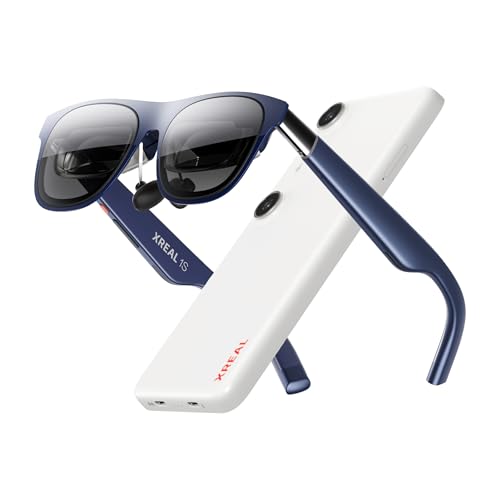
XREAL 1S & Beam Pro WiFi Bundle
Best for: portable spatial computing and gaming
- Virtual Screen Size
- 171 inches
- Refresh Rate
- 120Hz
- Brightness
- 700 nits
- Field of View
- 57°
- Tracking Degrees
- 3DoF/6DoF
- Panel Type
- Sony Micro-OLED
View on Amazon: XREAL 1S & Beam Pro WiFi Bundle Affiliate link
This bundle pairs XREAL 1S glasses with a Beam Pro companion. The glasses use Sony Micro-OLED displays with 1920x1200 resolution and a 120 Hz refresh rate. The Beam Pro runs Android 14 with 8GB of RAM and 256GB of storage. You get a 171-inch virtual screen and Bose-tuned audio. This setup suits users who want a portable spatial computing ecosystem for gaming and media.
Pros
- Sony Micro-OLED displays with 1920x1200 resolution
- 120 Hz refresh rate for smooth visuals
- Beam Pro includes 8GB RAM and 256GB storage
- Runs Android 14 with full Google Play access
- Bose-tuned high-fidelity audio system
Cons
- Limited to 3DoF/6DoF spatial tracking
- No mention of native Bluetooth audio support
- Requires separate Beam Pro device for full functionality
Good fit if
- You want a portable virtual theater experience
- You need Android apps in a spatial display
- You prefer high refresh rate visuals for gaming
Skip if
- You want standalone glasses without a companion device
- You need a larger field of view than 57 degrees
- You prefer a simpler single-device setup
Verdict: XREAL 1S Beam Pro Bundle delivers a versatile spatial computing experience with its high-resolution display and Android ecosystem. It is ideal for users seeking a portable, app-rich entertainment system.
Specifications side by side
| Spec | XREAL One Pro AR Glasses 120Hz | XREAL 1S & Beam Pro WiFi Bundle |
|---|---|---|
| Virtual Screen Size | 171" | 171 inches |
| Display Resolution | FHD | not stated |
| Refresh Rate | 120Hz | 120Hz |
| Brightness | up to 700 nits | 700 nits |
| Field of View | 57° | 57° |
| Tracking Degrees | 3DoF | 3DoF/6DoF |
| Panel Type | Micro-OLED | Sony Micro-OLED |
| Screen Resolution | 1080p | not stated |
| Operating System | Android | not stated |
| Color | Black | not stated |
| Platform | PC, Mobile, Mac, macOS | not stated |
| Dimensions | 1.97 × 3.94 × 1.97 inches | not stated |
| Weight | 3.07 ounces | not stated |
| Size | M (IPD 57-66mm) | not stated |
| Model | X1112 | not stated |
Frequently asked questions
Which glasses are better for USB-C devices?
The XREAL One Pro AR Glasses are the better choice for USB-C users. They are specifically designed to deliver a smooth 120Hz experience when connected via USB-C. This model prioritizes high refresh rates and comfort for direct device connections. It is ideal if you want stable visuals without needing an external processor.
Do the XREAL One Pro glasses have spatial tracking?
The One Pro focuses on comfort and refresh rate rather than full spatial tracking. It relies on the self-developed X1 chip for native 3DoF tracking. This setup provides ultra-low latency for stable visuals during movement. However, it does not offer the full spatial computing capabilities found in the 1S bundle.
Can I run Android apps on the One Pro glasses?
No, the One Pro does not include a built-in Android operating system. It is a standalone headset designed for USB-C connections. If you need to run native Android apps from the Google Play Store, you should choose the XREAL 1S and Beam Pro bundle instead. That model includes Android 14.
What is the IPD range for the XREAL One Pro?
The XREAL One Pro AR Glasses come in an M size. This size supports an interpupillary distance (IPD) range of 57 to 66mm. This fit is designed to accommodate a wide variety of users. The glasses also weigh just 3.07 ounces, making them lightweight for extended wear sessions.
Which option is best for portable gaming?
The XREAL 1S and Beam Pro WiFi bundle is best for portable gaming. It delivers a versatile spatial computing experience with a high-resolution display. The built-in Android 14 system allows you to run millions of apps directly. This makes it a complete entertainment system compared to the standalone glasses.
How heavy are the XREAL One Pro glasses?
The XREAL One Pro AR Glasses weigh 3.07 ounces. They measure 3.94 inches in width and 1.97 inches in both height and length. This compact size and light weight contribute to their comfort. The design is intended to provide a smooth experience without adding significant bulk to your setup.
Does the 1S bundle include a separate processor?
Yes, the XREAL 1S and Beam Pro WiFi bundle includes the Beam Pro. This component handles the processing power for the glasses. It works with the 1S display to provide a high-resolution viewing experience. This separation allows the glasses to remain lightweight while still delivering powerful spatial computing performance.