Pimax Crystal Light VR Headset vs Pimax Crystal Light QLED VR: Spec Comparison
As an Amazon Associate we earn from qualifying purchases. Links on this page are affiliate links.
You are comparing the pimax crystal light VR headset vs crystal light QLED VR. Both headsets share the same 2880x2880 per-eye resolution and 1.8-pound weight. They both use QLED displays with local dimming and support inside-out tracking. The main difference lies in their specific feature sets. One model highlights AI upscaling and flight sim optimization, while the other emphasizes foveated rendering and glass aspheric lenses. You need to decide which technical approach fits your gaming style.
Key differences
| Aspect | Pimax Crystal Light VR Headset | Pimax Crystal Light QLED VR Headset |
|---|---|---|
| Display Technology | QLED with local dimming | QLED with local dimming and HDR |
| Lens Type | Not listed | Glass aspheric lens |
| Rendering Tech | AI upscaling | Foveated Rendering Fixed 2.0 |
| Refresh Rate Options | 72Hz/90Hz/120Hz | Up to 120Hz |
| Weight | 1.8 pounds | 1.8 pounds |
Which one should you choose?
Choose Pimax Crystal Light VR Headset if
- You play flight and racing sims requiring high-detail graphics
- You want AI upscaling to boost frame rates
- You prefer options for 72Hz or 90Hz refresh rates
Choose Pimax Crystal Light QLED VR Headset if
- You want glass aspheric lenses for edge-to-edge clarity
- You need HDR support for vivid colors
- You want Foveated Rendering Fixed 2.0 to optimize performance
Verdict: The Pimax Crystal Light VR Headset suits sim gamers who value AI upscaling and flexible refresh rates. The Pimax Crystal Light QLED VR Headset is better for users who prioritize HDR, glass lenses, and foveated rendering. Your choice depends on whether you prefer visual optimization features or lens quality.
Specs: Refresh Rate and FOV
Refresh Rate Options
The Pimax Crystal Light VR Headset offers flexible refresh rate choices, allowing you to select between 72Hz, 90Hz, and 120Hz. This flexibility lets you match the output to your specific GPU performance, balancing visual smoothness with system load. The Pimax Crystal Light QLED VR Headset also supports up to 120Hz for ultra-low latency and fluid motion. While both reach the same maximum speed, the first model explicitly lists the lower options for broader compatibility with different hardware setups. This gives you more control over your experience if you have a less powerful PC.
Field of View
The Pimax Crystal Light VR Headset highlights a large field of view that is close to natural human vision, which enhances your sense of presence in virtual environments. This specification is a key part of its immersive design. The Pimax Crystal Light QLED VR Headset description does not explicitly state its field of view metrics in the provided data. Since both use similar display resolutions, the FOV likely varies, but only the first model confirms this benefit. If a wide, natural perspective is important to you, this explicit specification provides a clear advantage.
Display Technology
Both headsets utilize 8K QLED displays with local dimming, delivering sharp 2880x2880 resolution per eye. This shared technology ensures high contrast and vivid colors for both models. The Pimax Crystal Light VR Headset mentions AI upscaling to boost frame rates and clarity, which can help maintain smooth gameplay in demanding titles. The Pimax Crystal Light QLED VR Headset specifies HDR support and fixed 2.0 foveated rendering technology. Foveated rendering optimizes performance by focusing detail where you look. This advanced rendering technique offers a practical performance benefit that the other model does not list.
Lens Quality
The Pimax Crystal Light QLED VR Headset features glass aspheric lenses, which provide edge-to-edge clarity and reduce distortion. This optical quality ensures that the high resolution of the screen is maintained across the entire view. The Pimax Crystal Light VR Headset data does not specify the lens material or type. While both likely use high-quality optics to support their resolution, the explicit mention of glass aspheric lenses in the second model gives you confidence in peripheral sharpness. If clear edges are a priority, this specification is a notable plus.
Weight and Build
Both the Pimax Crystal Light VR Headset and the Pimax Crystal Light QLED VR Headset weigh 1.8 pounds. This identical weight suggests a similar ergonomic approach to long-term comfort. The first model notes a design that is 30% lighter than its predecessor with balanced weight distribution. The second model describes an ergonomic design for long-term use without burden. Since the final weight is the same, the comfort difference likely comes from distribution. Without specific distribution data for the second model, you cannot determine a clear advantage here.
Which Pimax Crystal Light should you buy
Flight and racing sim enthusiasts
This version is optimized for high-detail graphics in flight and racing sims. It supports AI upscaling to boost frame rates and clarity. You get razor-sharp details for small in-game text. The flexible refresh rates let you match your GPU. This setup ensures smoother high-FPS gameplay for demanding simulation titles.
Users wanting advanced rendering tech
This model features Fixed 2.0 Foveated Rendering. It optimizes performance by rendering high detail where you look while maintaining efficiency in peripheral areas. You also get glass aspheric lenses for edge-to-edge clarity. This reduces distortion and provides a fluid VR environment with minimal lag during intense sessions.
Buyers preferring easy setup
This headset emphasizes easy plug-and-play setup. You can complete room setup in ten minutes using the intuitive Pimax Play software. It supports inside-out tracking or expands with Lighthouse base stations. This straightforward process helps you get started quickly without complex configuration hurdles for your VR space.
The products compared
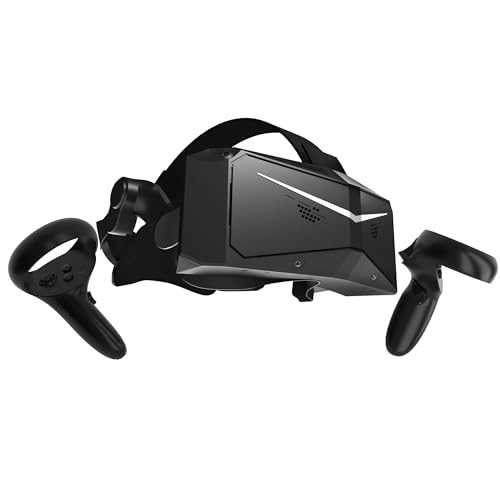
Pimax Crystal Light VR Headset
Best for: PC flight and racing simulators
- Display Resolution
- 2880×2880 per eye
- Refresh Rate
- 72Hz/90Hz/120Hz
- Display Type
- QLED
- Tracking Type
- Inside-Out, Base Station
- Color
- Black
- Platform
- PC
View on Amazon: Pimax Crystal Light VR Headset Affiliate link
This PC VR headset features an 8K QLED display with local dimming for high contrast. It offers 2880x2880 resolution per eye and 35 PPD for sharp text. The device weighs 1.8 pounds and supports 72Hz, 90Hz, or 120Hz refresh rates. It is optimized for flight and racing sims. You get inside-out tracking or Lighthouse compatibility. This setup suits users wanting immersive visuals without excessive weight.
Pros
- 2880x2880 resolution per eye with 35 PPD
- 8K QLED display with advanced local dimming
- Lightweight 1.8-pound design with balanced distribution
- Supports 72Hz, 90Hz, and 120Hz refresh rates
Cons
- Requires a capable PC GPU for high refresh rates
- No mention of standalone wireless capability
- Limited to PC platform compatibility
Good fit if
- You play flight and racing simulators
- You want high-resolution text clarity
- You prefer lightweight VR hardware
Skip if
- You need a standalone headset
- You rely on wireless connectivity
- You want a lower price point
Verdict: Pimax Crystal Light VR Headset delivers sharp 8K visuals and a lightweight build for PC sim enthusiasts. It fits users prioritizing display quality and comfort over wireless freedom.
Pimax Crystal Light QLED VR Headset
Best for: High resolution PC VR with local dimming
- Display Resolution
- 2880x2880 per eye
- Refresh Rate
- 120Hz
- Display Type
- QLED
- Tracking Type
- Inside-Out
- Color
- Black
- Platform
- PC
View on Amazon: Pimax Crystal Light QLED VR Headset Affiliate link
The Pimax Crystal Light VR Headset delivers 2880x2880 resolution per eye for sharp visuals. It uses QLED technology with local dimming for high contrast. You get up to 120Hz refresh rates for smooth motion. Inside-out tracking keeps you positioned accurately. The headset weighs 1.8 pounds. It fits PC users who want high fidelity and low latency in their VR sessions.
Pros
- 2880x2880 resolution per eye
- QLED display with local dimming
- Up to 120Hz refresh rate
- Inside-out camera tracking
- Foveated Rendering 2.0
Cons
- Fixed Foveated Rendering 2.0 limits customization
- 1.8 pounds weight may cause fatigue
- No mention of wireless connectivity
Good fit if
- You want high resolution per eye
- You prefer local dimming for contrast
- You use SteamVR compatible controllers
Skip if
- You need wireless freedom
- You want adjustable foveated rendering
- You prefer lighter headsets
Verdict: Pimax Crystal Light VR Headset suits PC users who prioritize high resolution and local dimming. It is a solid choice for those who do not need wireless connectivity.
Specifications side by side
| Spec | Pimax Crystal Light VR Headset | Pimax Crystal Light QLED VR Headset |
|---|---|---|
| Display Resolution | 2880×2880 per eye | 2880x2880 per eye |
| Refresh Rate | 72Hz/90Hz/120Hz | 120Hz |
| Display Type | QLED | QLED |
| Tracking Type | Inside-Out, Base Station | Inside-Out |
| Color | Black | Black |
| Platform | PC | PC |
| Dimensions | 15 × 12.5 × 6.7 inches | not stated |
| Weight | 1.8 pounds | 1.8 pounds |
| Size | 14.17 | not stated |
| Model | Crystal Light Full Payment Version | Full Payment Version |
Frequently asked questions
Is the Pimax Crystal Light VR Headset compatible with PC flight and racing simulators?
Yes, the Pimax Crystal Light VR Headset is designed for PC flight and racing simulators. It delivers sharp 8K visuals, which helps with small in-game text and high-detail graphics. The lightweight build at 1.8 pounds also ensures comfort during long simulation sessions. You get a solid experience for PC-based sim enthusiasts who prioritize display quality.
Does the Pimax Crystal Light QLED VR Headset support local dimming?
Yes, the Pimax Crystal Light QLED VR Headset supports local dimming. This feature enhances contrast and black levels, making it a solid choice for high-resolution PC VR. You will notice improved visual depth in dark scenes. It suits users who prioritize high resolution and local dimming over wireless connectivity.
What is the weight of the Pimax Crystal Light VR Headset?
The Pimax Crystal Light VR Headset weighs 1.8 pounds. This weight is shared with the QLED version, ensuring a consistent feel across models. The compact dimensions measure 14.17 inches in size, with a width of 12.5 inches and a height of 6.7 inches. This makes it relatively portable for a PC VR headset.
Can I use the Pimax Crystal Light VR Headset for wireless gaming?
No, the Pimax Crystal Light VR Headset is designed for PC use and does not offer wireless freedom. It fits users who prioritize display quality and comfort over wireless connectivity. You will need to connect it to your PC via cable to access its full features and high-resolution capabilities.
What color options are available for the Pimax Crystal Light headsets?
Both the Pimax Crystal Light VR Headset and the QLED version are available in Black. This consistent color scheme matches the sleek, professional look of most PC gaming setups. The black finish helps the headset blend seamlessly with your existing hardware, providing a unified aesthetic for your VR station.
Is the Pimax Crystal Light QLED VR Headset suitable for high-resolution PC VR?
Yes, the Pimax Crystal Light QLED VR Headset is suitable for high-resolution PC VR. It features QLED displays with local dimming, which improves image clarity and contrast. This makes it a solid choice for users who do not need wireless connectivity but want premium visual performance on their PC.