1080p vs WQXGA Handheld Gaming PCs in 2026: Key Differences
As an Amazon Associate we earn from qualifying purchases. Links on this page are affiliate links.
Choosing between a 1080p vs WQXGA handheld gaming PC comes down to balancing visual sharpness against system memory and portability. Both devices feature 1TB of PCIe storage and AMD processors designed for mobile gaming. However, their displays differ considerably. The HIDevolution ASUS ROG Ally X provides a 7-inch 1080p screen at 120Hz with 24GB of RAM, while the Lenovo Legion Go 2 features an 8.8-inch WQXGA OLED panel at 144Hz with 16GB of memory.
Key differences
| Aspect | HIDevolution ASUS ROG Ally X 7" 120Hz | Lenovo Legion Go 2 Handheld Gaming PC |
|---|---|---|
| Screen resolution | 1080p (1920 x 1080) | WQXGA |
| Display type and size | 7-inch IPS-level | 8.8-inch OLED |
| Refresh rate | 120Hz | 144Hz |
| Processor | AMD Ryzen Z1 Extreme | AMD Ryzen Z2 |
| RAM | 24GB LPDDR5X | 16GB |
| Weight | 1.49 pounds | 2.02 pounds |
Which one should you choose?
Choose HIDevolution ASUS ROG Ally X 7" 120Hz if
- You prioritize higher memory capacity with 24GB LPDDR5X RAM for multitasking and demanding games.
- You prefer a lighter handheld at 1.49 pounds for easier handheld comfort during extended play.
Choose Lenovo Legion Go 2 Handheld Gaming PC if
- You want a higher-resolution WQXGA OLED screen with deep contrast and a faster 144Hz refresh rate.
- You prefer a larger 8.8-inch display paired with the newer AMD Ryzen Z2 processor.
Verdict: The HIDevolution ASUS ROG Ally X suits you if you need 24GB of RAM and a lighter, compact 1080p design for everyday handling. The Lenovo Legion Go 2 is the better fit if you want higher-resolution WQXGA visuals, OLED panel contrast, and a faster 144Hz refresh rate on a larger screen. Your choice hinges on whether you value extra system memory and lower weight over screen resolution and display area.
1080p Versus WQXGA Handheld Comparison
Screen Resolution
The Lenovo Legion Go 2 features a WQXGA screen resolution, providing a much higher total pixel count across its display. This higher native resolution yields crisper details, sharp text, and cleaner edges in supported games without requiring aggressive anti-aliasing techniques. In contrast, the HIDevolution ASUS ROG Ally X provides a standard 1080p full high-definition display with 1920 x 1080 pixels. While a 1080p panel delivers fewer pixels overall, it puts less rendering demand on the graphics processor during mobile gaming. If your priority is maximum native clarity and pixel density, the Lenovo Legion Go 2 holds the clear technical advantage here.
Display Type and Refresh Rate
The Lenovo Legion Go 2 features an 8.8-inch PureSight OLED display running at a 144Hz refresh rate. The OLED panel produces deeper black levels, high color depth, and rapid response times alongside an extra 24Hz of frame fluidity. The HIDevolution ASUS ROG Ally X includes a 7-inch IPS-level touchscreen running at a 120Hz refresh rate with a 7ms response time. Although the Ally X display provides solid fluid motion for fast-paced titles, it cannot match the contrast capabilities of an organic light-emitting diode panel or the higher refresh ceiling of the competing device. The Lenovo Legion Go 2 offers the superior visual hardware.
RAM and System Memory
Memory headroom matters when handheld processors share memory between system processes and graphics hardware. The HIDevolution ASUS ROG Ally X comes equipped with 24GB of LPDDR5X onboard memory in a dual-channel configuration. Having 24GB allows you to allocate generous pools of memory to graphical assets while keeping ample room for background tasks. By comparison, the Lenovo Legion Go 2 supplies 16GB of system RAM. While 16GB handles standard gaming needs, it gives you less flexibility when balancing video buffer demands alongside memory-heavy modern installations. The extra 8GB of memory on the HIDevolution ASUS ROG Ally X gives it an edge for complex multitasking.
Build Dimensions and Portability
Physical proportions affect comfort during extended handheld play sessions. The HIDevolution ASUS ROG Ally X measures 11 inches long, 4.37 inches wide, and 1.45 inches tall, with an overall weight of 1.49 pounds. In comparison, the Lenovo Legion Go 2 is larger and heavier across every dimension. It measures 11.7 inches long, 5.39 inches wide, and 1.65 inches thick, weighing 2.02 pounds. That extra half-pound of mass and wider chassis can lead to quicker wrist fatigue during long portable sessions without a desk surface. For handheld comfort and compact travel convenience, the HIDevolution ASUS ROG Ally X is easier to hold and carry.
Storage Capacity and Interface
Both handhelds offer generous internal space for downloading modern gaming libraries. The HIDevolution ASUS ROG Ally X includes a 1TB M.2 2280 PCIe 4.0 x4 NVMe solid-state drive, ensuring fast system boot times and quick game load speeds. Similarly, the Lenovo Legion Go 2 provides a 1TB PCIe solid-state drive for storing titles, updates, and media files without requiring immediate expansion. Because both devices provide identical baseline storage capacities running on high-speed PCIe architecture, neither device holds an advantage out of the box. Both give you 1TB of rapid storage for installing several large titles at the same time.
Choosing Your Handheld Gaming PC
Players seeking lighter hardware and heavy multitasking memory
You should choose this handheld if you prioritize portability and high system memory. Its 1.49-pound weight makes it lighter to hold than larger alternatives. You also get 24GB of LPDDR5X memory paired with an 8-core AMD Ryzen Z1 Extreme processor, giving you extra headroom for demanding background tasks and memory-heavy PC games.
Shooters fans wanting flexible controls and high refresh rates
Select this model if you want versatile input methods and fast motion clarity. Its detachable Truestrike controllers allow you to use the right controller as a mouse in FPS mode. You benefit from a 144Hz refresh rate on the 8.8-inch OLED panel, driven by the AMD Ryzen Z2 processor.
Travelers seeking a compact chassis and standard touch control
Choose this option if you want a smaller footprint for travel. Measuring 11 inches long and 1.45 inches thick, it fits easily into bags. Its 7-inch IPS-level display includes touch screen capability, offering direct finger navigation across Windows 11 Home alongside its standard gamepad layout.
Quick picks
| # | Product | Best for | Price |
|---|---|---|---|
| 1 | HIDevolution ASUS ROG Ally X 7" 120Hz | Users needing 24GB RAM and a 120Hz screen | Check price of HIDevolution ASUS ROG Ally X 7" 120Hz on Amazon |
| 2 | Lenovo Legion Go 2 Handheld Gaming PC | high-fidelity OLED handheld gaming | Check price of Lenovo Legion Go 2 Handheld Gaming PC on Amazon |
The products compared

HIDevolution ASUS ROG Ally X 7" 120Hz
Best for: Users needing 24GB RAM and a 120Hz screen
- Screen Resolution
- 1080p (what this guide is about)
- Processor
- AMD Ryzen Z1 Extreme
- RAM
- 24GB LPDDR5X
- Storage
- 1TB PCIe SSD
- Screen Size
- 7"
- Refresh Rate
- 120Hz
View on Amazon: HIDevolution ASUS ROG Ally X 7" 120Hz Affiliate link
This HIDevolution build uses the ASUS ROG Ally X chassis with a Ryzen Z1 Extreme processor and 24 GB of LPDDR5X RAM. The 7-inch 1080p display runs at 120Hz. You get 1 TB of PCIe 4.0 SSD storage. It runs Windows 11 Home. This setup suits players who want high-end mobile PC power in a handheld form factor with ample memory for multitasking.
Pros
- Ryzen Z1 Extreme processor with 8 cores
- 24 GB LPDDR5X system memory
- 1 TB PCIe 4.0 NVMe SSD
- 7-inch 120Hz FHD touchscreen
Cons
- 1080p resolution limits sharpness on a 7-inch screen
- Windows 11 Home lacks advanced enterprise features
- 1.49-pound weight adds fatigue during long sessions
Good fit if
- You need maximum RAM for heavy multitasking
- You prefer a larger 7-inch display
- You want fast PCIe 4.0 load times
Skip if
- You require Windows 11 Pro
- You prioritize 4K screen clarity
- You want a lighter device under 1.4 pounds
Verdict: HIDevolution ASUS ROG Ally X 7" 24GB delivers strong mobile performance with 24 GB of RAM and a fast SSD. It fits users who prioritize memory capacity and a large 120Hz display over higher screen resolution or a lighter build.
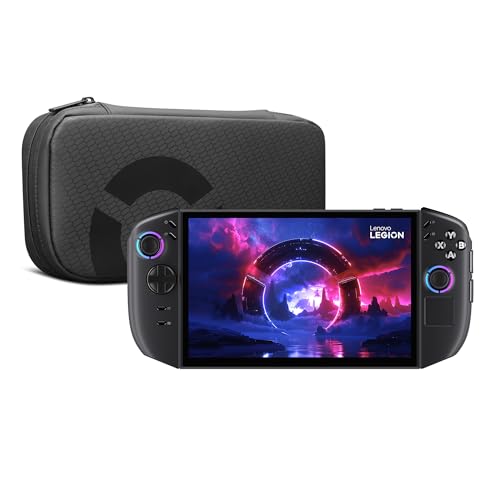
Lenovo Legion Go 2 Handheld Gaming PC
Best for: high-fidelity OLED handheld gaming
- Screen Resolution
- WQXGA (what this guide is about)
- Processor
- AMD Ryzen Z2
- RAM
- 16GB
- Storage
- 1TB
- Screen Size
- 8.8"
- Refresh Rate
- 144Hz
View on Amazon: Lenovo Legion Go 2 Handheld Gaming PC Affiliate link
The Lenovo Legion Go 2 is a mobile gaming console featuring an AMD Ryzen Z2 processor and an 8.8-inch WQXGA OLED display. It includes 16GB of RAM and a 1TB PCIe SSD for fast performance. The device supports 144Hz refresh rates and offers a 74Whr battery for extended play. It connects via Wi-Fi 6E and Bluetooth 5.3. This system suits players who want high-resolution visuals and detachable controllers for versatile gaming.
Pros
- 8.8-inch WQXGA OLED display with 144Hz refresh rate
- AMD Ryzen Z2 processor and 16GB RAM
- 1TB PCIe SSD storage capacity
- Detachable Truestrike controllers with mouse mode
- 74Whr battery for extended unplugged sessions
Cons
- 2.02 pounds weight is substantial for handheld use
- 11.7 inches length may reduce portability
- Integrated dual 2W speakers lack bass depth
Good fit if
- You prioritize high-resolution OLED visuals and fast refresh rates
- You want detachable controllers for mouse-like aiming in FPS games
- You need ample storage for large game libraries
Skip if
- You prefer a lighter device for extended carrying
- You require integrated controllers for maximum compactness
- You are sensitive to device weight during long sessions
Verdict: Lenovo Legion Go 2 8.8" OLED delivers high-end specs with its OLED panel and Ryzen Z2 chip. It fits gamers who value visual fidelity and versatile controller configurations over ultra-portability.
Specifications side by side
| Spec | HIDevolution ASUS ROG Ally X 7" 120Hz | Lenovo Legion Go 2 Handheld Gaming PC |
|---|---|---|
| Processor | AMD Ryzen Z1 Extreme | AMD Ryzen Z2 |
| RAM | 24GB LPDDR5X | 16GB |
| Storage | 1TB PCIe SSD | 1TB |
| Screen Size | 7" | 8.8" |
| Refresh Rate | 120Hz | 144Hz |
| Display Type | IPS-Level | OLED |
| Resolution | 1920x1080 | WQXGA |
| Graphics | AMD Radeon Graphics | AMD Radeon Graphics |
| Operating System | Windows 11 Home | not stated |
| Storage Capacity | 1TB | 1TB |
| Screen Resolution | 1080p | WQXGA |
| Color | 7" Fhd | Ryzen Z1 Extreme | Amd Radeon | 11 Home | Black |
| Graphics Card | AMD Radeon | AMD Radeon |
| Memory | not stated | 16GB |
| Platform | PC | Mobile |
| Dimensions | 11 × 4.37 × 1.45 inches | 11.7 × 5.39 × 1.65 inches |
| Weight | 1.49 pounds | 2.02 pounds |
| Size | 24 GB LPDDR5X RAM | 1 TB PCIe SSD | not stated |
| Model | RC72LA-ALLYX.Z1X-HID1 | 83N10009US |
Frequently asked questions
What is the main display difference between 1080p and WQXGA handheld gaming PCs?
WQXGA provides a higher pixel resolution than standard 1080p displays. In this lineup, the Lenovo Legion Go 2 features an 8.8-inch WQXGA OLED screen, while the HIDevolution ASUS ROG Ally X runs a 7-inch 1080p screen. The WQXGA panel delivers a denser image grid, though both use AMD Radeon graphics to drive gameplay.
Which refresh rates do 1080p and WQXGA handhelds support?
Refresh rates vary by specific panel rather than resolution alone. The WQXGA Lenovo Legion Go 2 supports up to a 144Hz refresh rate on its 8.8-inch screen. The 1080p HIDevolution ASUS ROG Ally X operates at a 120Hz refresh rate. Higher refresh rates enable your device to render frame updates more smoothly during active play.
How do processor options differ between these handheld PC models?
These devices rely on distinct AMD processor generations. The 1080p HIDevolution ASUS ROG Ally X runs an AMD Ryzen Z1 Extreme processor. In contrast, the WQXGA Lenovo Legion Go 2 uses an AMD Ryzen Z2 processor. Both processors include integrated AMD Radeon graphics to manage rendering directly on their respective screens.
How does memory capacity compare between 1080p and WQXGA handhelds here?
The 1080p handheld on this list provides higher memory capacity than the WQXGA alternative. The HIDevolution ASUS ROG Ally X carries 24GB of LPDDR5X RAM. The Lenovo Legion Go 2 includes 16GB of RAM. Having more system memory ensures you have adequate shared capacity for graphics allocation alongside your active background processes.
How do the physical dimensions compare between these two devices?
The 1080p model has a smaller overall footprint than the WQXGA handheld. The HIDevolution ASUS ROG Ally X measures 11 by 4.37 by 1.45 inches. Meanwhile, the Lenovo Legion Go 2 measures 11.7 by 5.39 by 1.65 inches. The Lenovo device requires more physical space to house its larger 8.8-inch display panel.
What storage space is available on these handheld gaming PCs?
Both handheld gaming PCs supply 1TB of built-in storage capacity. The HIDevolution ASUS ROG Ally X uses a 1TB PCIe SSD, while the Lenovo Legion Go 2 also lists 1TB of internal storage. This gives you ample room to download large game installations directly to either unit out of the box.
Which operating systems do these handheld devices use?
The HIDevolution ASUS ROG Ally X runs Windows 11 Home as its operating system. This provides you with standard Windows compatibility for PC game launchers and desktop applications. The Lenovo Legion Go 2 is categorized as a mobile PC platform device and utilizes AMD Radeon graphics alongside its AMD Ryzen Z2 processing architecture.