WQXGA vs QHD Handheld Gaming PCs: Which Should You Buy?
As an Amazon Associate we earn from qualifying purchases. Links on this page are affiliate links.
Choosing between a WQXGA vs QHD handheld gaming PC often comes down to how you prefer to play. Both devices offer high-refresh OLED panels for vivid visuals. The Lenovo Legion Go 2 features an 8.8-inch built-in screen with 144Hz refresh rates. The Goovis G3 Max uses QHD micro-OLED displays in a headset form factor with 120Hz support. Your choice depends on whether you want a traditional handheld or a portable theater experience.
Key differences
| Aspect | Lenovo Legion Go 2 Handheld Gaming PC | Goovis G3 Max QHD Micro-OLED Headset |
|---|---|---|
| Screen Resolution | WQXGA | QHD |
| Screen Size | 8.8-Inch | Not listed |
| Refresh Rate | 144Hz | 120Hz |
| Processor | AMD Ryzen Z2 | Not listed |
| RAM | 16GB | Not listed |
| Platform | Mobile | PC, Mobile, PS5 |
Which one should you choose?
Choose Lenovo Legion Go 2 Handheld Gaming PC if
- You want a standalone device with an integrated high-refresh OLED screen.
- You need a powerful AMD Ryzen Z2 processor and 16GB of RAM for native gaming.
- You prefer a traditional handheld form factor with detachable controllers.
Choose Goovis G3 Max QHD Micro-OLED Headset if
- You want a headset that simulates a large virtual screen for movies and games.
- You need compatibility with external devices like a Steam Deck, PS5, or PC via USB-C.
- You want diopter and IPD adjustments for a personalized visual fit.
Verdict: The Lenovo Legion Go 2 is the better choice for dedicated handheld gaming with its integrated screen and powerful internal specs. The Goovis G3 Max suits users who prioritize a cinematic, immersive visual experience via a headset. Your decision rests on whether you need a self-contained console or a versatile display accessory.
WQXGA vs QHD Handheld Specs
Screen resolution
The Lenovo Legion Go 2 uses a WQXGA display, which provides a higher pixel density than the QHD resolution found in the Goovis G3 Max. WQXGA typically refers to a 2560x1600 panel, while QHD is often 2560x1440. This means the Lenovo screen offers slightly sharper detail for the same physical size. You get more pixels per inch on the Legion Go 2, which can make text and fine game textures appear crisper. The Goovis uses dual QHD micro-OLED panels, but the total pixel count is lower than the single WQXGA panel. If you prioritize maximum sharpness on a single screen, the WQXGA panel has the advantage.
Refresh rate
Smooth motion is critical for fast-paced games. The Lenovo Legion Go 2 supports a 144Hz refresh rate on its OLED display. The Goovis G3 Max tops out at 120Hz. While both are well above the standard 60Hz baseline, the Lenovo panel updates the image 24 times per second more than the Goovis. This extra frame rate can reduce motion blur and make aiming feel more responsive in shooters or racing games. The difference is noticeable if you are used to high-refresh monitors. The Legion Go 2 wins here for those who want the smoothest possible visual flow.
Processor
The Lenovo Legion Go 2 is powered by an AMD Ryzen Z2 CPU. This is a dedicated mobile processor designed for high-performance handheld gaming. The Goovis G3 Max does not list a specific CPU model in its attributes, only noting an Android operating system. The Ryzen Z2 is built to handle demanding AAA titles and complex game logic. Without a listed processor for the Goovis, we cannot compare raw computational power directly. However, the Legion Go 2 is clearly optimized for heavy gaming loads, giving it a clear edge in processing capability.
RAM
Memory affects how many games you can keep loaded and how smoothly multitasking works. The Lenovo Legion Go 2 comes with 16GB of RAM. The Goovis G3 Max does not specify its RAM capacity in the provided data. 16GB is a substantial amount for a handheld, allowing for high settings and background tasks. The lack of RAM data for the Goovis makes a direct comparison impossible. However, for serious gaming, the confirmed 16GB in the Lenovo device ensures you have enough memory for modern titles. The Lenovo has the advantage here due to confirmed high capacity.
Storage capacity
Game libraries are growing larger every year. The Lenovo Legion Go 2 includes 1TB of PCIe SSD storage. This gives you plenty of room for many large games. The Goovis G3 Max does not list any internal storage capacity in its attributes. This suggests it relies on external devices or does not store games internally. For a handheld gaming PC, having 1TB of fast storage is a significant benefit. You can install multiple AAA games without worrying about space. The Lenovo Legion Go 2 wins this round decisively.
Screen size
The Lenovo Legion Go 2 features an 8.8-inch built-in display. This is a large screen for a handheld device, providing ample space for immersive gaming. The Goovis G3 Max is a head-mounted display that simulates a 1000-inch virtual screen. While the virtual screen is larger, it is viewed through a headset, not a built-in panel. For traditional handheld play, the 8.8-inch screen is more practical and versatile. You can hold it in your hands or dock it. The Goovis requires wearing a headset. For standard handheld usage, the Lenovo screen size is more suitable.
Compatibility
The Goovis G3 Max connects via USB-C or HDMI to various devices, including PCs, PS5, and phones. It acts as a portable monitor or headset. The Lenovo Legion Go 2 is a standalone mobile gaming console with its own OS and hardware. It does not list external device compatibility in the same way. The Goovis is more flexible as a display for other systems. The Lenovo is a complete gaming unit. For compatibility with external devices, the Goovis has the edge. For a self-contained gaming experience, the Lenovo is superior.
Which handheld gaming PC suits you
Players wanting a traditional handheld PC
The Lenovo Legion Go 2 offers an 8.8-inch WQXGA OLED display with a 144Hz refresh rate. It includes 16GB RAM and 1TB storage. The AMD Ryzen Z2 processor and 74Whr battery support long gaming sessions. Detachable controllers allow flexible input methods for various game genres.
Users preferring a large virtual screen
The Goovis G3 Max provides a 1000-inch virtual screen using dual 2.5K QHD Micro-OLED displays. It features a 120Hz refresh rate for smooth visuals. The headset supports Blu-ray 3D and adjusts to individual eye prescriptions. It connects via USB-C to compatible devices like PCs or consoles.
Gamers needing high performance and portability
This device combines an 8.8-inch WQXGA OLED panel with a 144Hz refresh rate for clear, fast visuals. The AMD Ryzen Z2 CPU and 16GB RAM ensure responsive performance. A 1TB PCIe SSD provides ample storage. The 74Whr battery and efficient cooling system maintain power during extended play.
Quick picks
| # | Product | Best for | Price |
|---|---|---|---|
| 1 | Lenovo Legion Go 2 Handheld Gaming PC | high-fidelity OLED handheld gaming | Check price of Lenovo Legion Go 2 Handheld Gaming PC on Amazon |
| 2 | Goovis G3 Max QHD Micro-OLED Headset | immersive portable gaming and movie watching | Check price of Goovis G3 Max QHD Micro-OLED Headset on Amazon |
The products compared
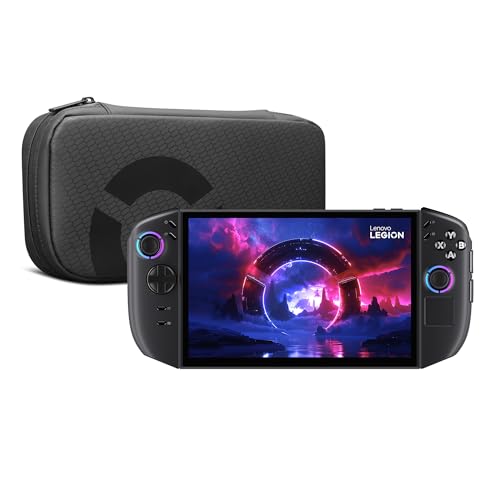
Lenovo Legion Go 2 Handheld Gaming PC
Best for: high-fidelity OLED handheld gaming
- Screen Resolution
- WQXGA (what this guide is about)
- Processor
- AMD Ryzen Z2
- RAM
- 16GB
- Storage
- 1TB
- Screen Size
- 8.8"
- Refresh Rate
- 144Hz
View on Amazon: Lenovo Legion Go 2 Handheld Gaming PC Affiliate link
The Lenovo Legion Go 2 is a mobile gaming console featuring an AMD Ryzen Z2 processor and an 8.8-inch WQXGA OLED display. It includes 16GB of RAM and a 1TB PCIe SSD for fast performance. The device supports 144Hz refresh rates and offers a 74Whr battery for extended play. It connects via Wi-Fi 6E and Bluetooth 5.3. This system suits players who want high-resolution visuals and detachable controllers for versatile gaming.
Pros
- 8.8-inch WQXGA OLED display with 144Hz refresh rate
- AMD Ryzen Z2 processor and 16GB RAM
- 1TB PCIe SSD storage capacity
- Detachable Truestrike controllers with mouse mode
- 74Whr battery for extended unplugged sessions
Cons
- 2.02 pounds weight is substantial for handheld use
- 11.7 inches length may reduce portability
- Integrated dual 2W speakers lack bass depth
Good fit if
- You prioritize high-resolution OLED visuals and fast refresh rates
- You want detachable controllers for mouse-like aiming in FPS games
- You need ample storage for large game libraries
Skip if
- You prefer a lighter device for extended carrying
- You require integrated controllers for maximum compactness
- You are sensitive to device weight during long sessions
Verdict: Lenovo Legion Go 2 8.8" OLED delivers high-end specs with its OLED panel and Ryzen Z2 chip. It fits gamers who value visual fidelity and versatile controller configurations over ultra-portability.

Goovis G3 Max QHD Micro-OLED Headset
Best for: immersive portable gaming and movie watching
- Screen Resolution
- QHD (what this guide is about)
- Refresh Rate
- 120Hz
- Display Type
- OLED
- Operating System
- Android
- Color
- Silver
- Platform
- PC, Mobile, PS5
View on Amazon: Goovis G3 Max QHD Micro-OLED Headset Affiliate link
The Goovis G3 Max XR is a head-mounted display featuring dual 2.5K Sony Micro-OLED panels. It delivers a 1000-inch virtual screen with QHD resolution and a 120Hz refresh rate. This setup supports Blu-ray 3D and connects to USB-C devices like the Steam Deck. It includes diopter and IPD adjustments for comfort. It suits users seeking an immersive, portable theater experience for gaming and movies.
Pros
- Dual 2.5K Sony Micro-OLED displays for QHD clarity
- 120Hz refresh rate for smooth motion
- Supports Blu-ray 3D and Side-by-Side formats
- Adjustable diopter from +2.0D to -7.0D
- Mechanical IPD adjustment from 58mm to 74mm
Cons
- Requires external power source or battery pack
- No built-in speakers for audio
- Heavy for a headset at 300g
Good fit if
- You want a large virtual screen for portable gaming
- You need diopter adjustment to avoid wearing glasses
- You connect to USB-C devices like the Steam Deck
Skip if
- You prefer a traditional handheld PC with a built-in screen
- You need built-in audio without headphones
- You want a lightweight device for all-day wear
Verdict: Goovis G3 Max XR QHD Headset offers high-resolution visuals and smooth refresh rates for immersive portable entertainment. It is best for users who prioritize screen size and clarity over traditional handheld form factors.
Specifications side by side
| Spec | Lenovo Legion Go 2 Handheld Gaming PC | Goovis G3 Max QHD Micro-OLED Headset |
|---|---|---|
| Processor | AMD Ryzen Z2 | not stated |
| RAM | 16GB | not stated |
| Storage | 1TB | not stated |
| Screen Size | 8.8" | not stated |
| Refresh Rate | 144Hz | not stated |
| Display Type | OLED | not stated |
| Resolution | WQXGA | not stated |
| Graphics | AMD Radeon Graphics | not stated |
| Storage Capacity | 1TB | not stated |
| Screen Resolution | WQXGA | QHD |
| Operating System | not stated | Android |
| Color | Black | Silver |
| Graphics Card | AMD Radeon | not stated |
| Memory | 16GB | not stated |
| Platform | Mobile | PC, Mobile, PS5 |
| Dimensions | 11.7 × 5.39 × 1.65 inches | 9.13 × 8.39 × 4.41 inches |
| Weight | 2.02 pounds | not stated |
| Model | 83N10009US | ea3ad4db-e94a-4c04-b22d-2f3e152e2d44 |
Frequently asked questions
Is WQXGA better than QHD for handheld gaming?
WQXGA offers higher pixel density than QHD. The Lenovo Legion Go 2 uses a WQXGA panel with 2560x1600 resolution. This provides sharper images compared to the 2560x1440 QHD display in the Goovis G3 Max. You get more detail on the built-in screen.
Does the Lenovo Legion Go 2 have a WQXGA screen?
Yes, the Lenovo Legion Go 2 features a WQXGA OLED display. It measures 8.8 inches and supports a 144Hz refresh rate. The AMD Ryzen Z2 processor drives this high-resolution panel. You benefit from vivid visuals and smooth motion in handheld games.
What resolution does the Goovis G3 Max use?
The Goovis G3 Max QHD headset uses a QHD resolution. It features a Micro-OLED display with a 120Hz refresh rate. This headset connects to PC, Mobile, and PS5 devices. You get immersive visuals in a wearable format rather than a traditional handheld.
Which handheld has the higher refresh rate?
The Lenovo Legion Go 2 has a 144Hz refresh rate. The Goovis G3 Max offers a 120Hz refresh rate. Both use OLED panels for fast response times. You get smoother gameplay on the Legion Go 2 compared to the headset.
Is WQXGA suitable for portable gaming?
WQXGA is suitable for portable gaming if you prioritize visual fidelity. The Lenovo Legion Go 2 delivers high-end specs with its OLED panel. It includes 16GB RAM and 1TB storage. You get a powerful device for high-fidelity handheld gaming on the go.
Does QHD provide good clarity for VR headsets?
QHD provides good clarity for VR headsets like the Goovis G3 Max. It offers high-resolution visuals for immersive entertainment. The Micro-OLED panel ensures sharp images. You get a clear view for gaming and movie watching in a portable headset format.
Can I connect the Goovis G3 Max to a PS5?
Yes, the Goovis G3 Max connects to a PS5. It supports PC, Mobile, and PS5 platforms. The QHD Micro-OLED display delivers smooth visuals. You can use it for immersive portable gaming or movie watching from your console.
What is the screen size of the WQXGA handheld?
The WQXGA handheld, Lenovo Legion Go 2, has an 8.8-inch screen. It features an OLED display with 144Hz refresh rate. The device weighs 2.02 pounds. You get a substantial built-in screen for traditional handheld gaming experiences.