ONEXPLAYER or LANRUO? Handheld Gaming PCs Compared in 2026
As an Amazon Associate we earn from qualifying purchases. Links on this page are affiliate links.
Evaluating an ONEXPLAYER vs LANRUO handheld gaming PC comes down to form factor and internal architecture. Both devices feature 8.8-inch 144Hz displays, 32GB of RAM, 1TB of storage, and Windows 11. The ONEXPLAYER 3 uses an Arc G3 Extreme processor with an 85Wh battery and a native landscape AMOLED panel. In contrast, the LANRUO GPD Pocket 4 provides an AMD Ryzen AI 9 HX-370 chip, a higher-resolution LTPS rotating display, and modular expansion ports.
Key differences
| Aspect | ONEXPLAYER 3 8.8" 3-in-1 Handheld | LANRUO GPD Pocket 4 8.8" 144Hz |
|---|---|---|
| Processor | Arc G3 Extreme | AMD Ryzen AI 9 HX-370 |
| Display type | AMOLED | LTPS |
| Screen resolution | 1920x1200 | 2560x1600 |
| Battery capacity | 85Wh | 44.8Wh |
| Design form factor | 3-in-1 with detachable controllers | Modular notebook with rotating screen |
Which one should you choose?
Choose ONEXPLAYER 3 8.8" 3-in-1 Handheld if
- You want an AMOLED screen paired with detachable controllers for tablet, laptop, and handheld configurations.
- You prefer a larger 85Wh battery for longer running time between charges.
- You prioritize dual USB4 ports and standard M.2 2280 PCIe 4.0 SSD upgrade support.
Choose LANRUO GPD Pocket 4 8.8" 144Hz if
- You prefer an AMD Ryzen AI 9 HX-370 processor with Radeon 890M integrated graphics.
- You want a higher-density 2560x1600 display with 500 nits brightness.
- You need native keyboard input, built-in RJ45 Ethernet, HDMI 2.1, and modular port slots.
Verdict: Choose the ONEXPLAYER 3 if you prioritize detachable handheld controls, AMOLED visuals, and an 85Wh battery. Select the LANRUO GPD Pocket 4 if you require a higher-resolution display, a built-in keyboard, and legacy wired ports like RJ45 and HDMI. Both systems offer 32GB of memory and smooth 144Hz refresh rates for portable Windows 11 use.
ONEXPLAYER 3 Versus LANRUO GPD Pocket 4
Display panel technology
ONEXPLAYER 3 uses an 8.8-inch native landscape AMOLED panel with variable refresh rate (VRR), HDR support, and 100% DCI-P3 color gamut. In contrast, the LANRUO GPD Pocket 4 features an 8.8-inch LTPS screen reaching 500 nits brightness, DC dimming, and 97% DCI-P3 color gamut coverage. Both displays refresh at 144Hz for fluid movement during games. The AMOLED hardware on the ONEXPLAYER 3 provides complete DCI-P3 color reproduction, HDR support, and VRR capabilities that adapt smoothly to shifting frame rates. These features give the ONEXPLAYER 3 an advantage if you prioritize rich contrast and variable refresh synchronization over standard LTPS output.
Screen resolution and clarity
Screen detail differs noticeably between these two 8.8-inch handhelds. The ONEXPLAYER 3 operates at a resolution of 1920x1200 pixels in a 16:10 aspect ratio. Meanwhile, the LANRUO GPD Pocket 4 provides a sharper 2.5K display running at 2560x1600 pixels. That gives the LANRUO panel a pixel density of 343 pixels per inch. While the ONEXPLAYER resolution requires less rendering power from the GPU, the LANRUO panel displays finer lines, sharper text, and clearer desktop elements. If you want maximum screen sharpness for detailed game visuals, productivity software, and reading, the higher pixel count gives the LANRUO GPD Pocket 4 a distinct lead.
Battery capacity and endurance
Battery sizing marks one of the most substantial hardware differences between these systems. The ONEXPLAYER 3 houses an 85Wh battery that delivers 2 to 3 hours of heavy gaming and over 25 hours during office tasks. In comparison, the LANRUO GPD Pocket 4 comes with a smaller 44.8Wh battery. The manufacturer lists the LANRUO runtime at 2 hours under heavy loads, 4 to 9 hours for moderate tasks, and up to 10 hours of light use, backed by 100W PD fast charging. Because the ONEXPLAYER 3 packs almost double the watt-hour volume, it provides significantly longer endurance away from a wall outlet.
Physical connectivity and modular ports
Connectivity options cater to different usage habits. The ONEXPLAYER 3 keeps physical connections simple with dual USB4 ports and a 3.5mm audio jack. The LANRUO GPD Pocket 4 offers a much broader array of built-in ports. It features one USB4 port, an HDMI 2.1 port, a full-featured USB-C 3.2 Gen 2 port, a USB-A 3.2 Gen 2 port, a USB-A 2.0 port, an RJ45 network jack, and a 3.5mm headset jack. Furthermore, the LANRUO includes a modular port bay supporting a microSD reader, with optional modules for RS-232, 4G LTE, and KVM. This extensive layout gives the LANRUO GPD Pocket 4 a clear advantage for versatile peripheral connections.
Memory and internal storage
Looking at base capacity, both handheld computers share identical memory and baseline solid-state drive numbers. The ONEXPLAYER 3 includes 32GB of high-speed LPDDR5X RAM alongside a 1TB PCIe 4.0 2280 SSD, which you can upgrade later. The LANRUO GPD Pocket 4 similarly comes configured with 32GB of RAM and a 1TB storage drive. Both setups offer plenty of room for modern games, productivity applications, and simultaneous background tasks without encountering system memory bottlenecks. Because both models provide 32GB of memory and 1TB of base storage out of the box, neither unit holds a decisive technical edge in this category.
Choosing Your Handheld Gaming PC
Players wanting modular controls and tablet conversion
The ONEXPLAYER 3 includes detachable controllers that let you switch between handheld, tablet, and mini-laptop formats. You get an 85Wh battery for longer unplugged gaming, fingerprint recognition for security, and two USB4 ports. Internal storage also upgrades easily through its PCIe 4.0 2280 SSD slot.
Professionals requiring built-in Ethernet and legacy ports
The GPD Pocket 4 provides a dedicated RJ45 network port, HDMI 2.1, and multiple USB-A ports directly on the chassis. It includes a standard MicroSD modular slot and 100W PD charging that refills 50 percent in 30 minutes. You also get a 12-core AMD Ryzen AI 9 HX-370 processor.
Mobile workers seeking high-density displays and rotating hinges
This model provides a 2560x1600 rotating screen reaching 343 ppi alongside DC dimming. Its AMD Radeon 890M graphics chip delivers 16 graphics cores running at 2900 MHz. Weighing 725 grams, it pairs 32GB of RAM with 1TB of storage, giving you a sharp display and high-clocked CPU boosting up to 5.1 GHz.
The products compared

ONEXPLAYER 3 8.8" 3-in-1 Handheld
Best for: portable 3-in-1 gaming and work
- Processor
- Arc G3 Extreme
- RAM
- 32GB LPDDR5X
- Storage
- 1TB SSD
- Screen Size
- 8.8"
- Refresh Rate
- 144Hz
- Display Type
- AMOLED
View on Amazon: ONEXPLAYER 3 8.8" 3-in-1 Handheld Affiliate link
The ONEXPlayer 3 is a 3-in-1 handheld PC featuring an 8.8-inch 144Hz AMOLED touchscreen. It runs on Windows 11 with an Arc G3 Extreme processor and 32GB LPDDR5X RAM. The device supports gaming, tablet, and laptop modes. You get a 1TB SSD and an 85Wh battery. This setup handles AAA titles and productivity tasks on one portable device.
Pros
- 8.8-inch 144Hz AMOLED display with HDR
- 32GB LPDDR5X RAM for multitasking
- Arc G3 Extreme processor performance
- Detachable controllers for three usage modes
- Dual USB4 ports for connectivity
Cons
- Smaller 8.8-inch screen compared to larger competitors
- 2-3 hours of heavy gaming battery life
- Limited to 1920x1200 resolution on AMOLED panel
Good fit if
- You want a compact 3-in-1 device
- You need high RAM for productivity
- You prefer AMOLED display quality
Skip if
- You require a larger screen size
- You need all-day heavy gaming endurance
- You prefer a traditional laptop form factor
Verdict: ONEXPlayer 3 8.8" AMOLED Handheld suits users who prioritize portability and display quality over raw screen real estate. It fits those who need a versatile device for gaming and office work.
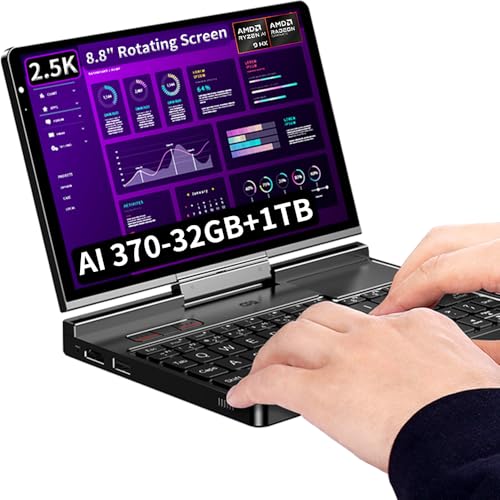
LANRUO GPD Pocket 4 8.8" 144Hz
Best for: portable productivity and high-res gaming
- Processor
- AMD Ryzen A1 9 HX-370
- RAM
- 32GB
- Storage
- 1TB
- Screen Size
- 8.8"
- Refresh Rate
- 144Hz
- Display Type
- LTPS
View on Amazon: LANRUO GPD Pocket 4 8.8" 144Hz Affiliate link
The GPD Pocket 4 is an 8.8-inch handheld PC with a rotating screen. It uses an AMD Ryzen AI 370 processor with 12 cores and 24 threads. The display offers 2560x1600 resolution at 144Hz. You get 32GB of RAM and 1TB of storage. This setup supports demanding tasks and smooth visuals. It suits users who need a compact, modular device with strong performance.
Pros
- AMD Ryzen AI 370 CPU with up to 5.1 GHz turbo
- 8.8-inch 144Hz LTPS display with 2560x1600 resolution
- 32GB RAM and 1TB storage capacity
- Modular I/O ports including optional LTE and KVM
Cons
- 725 grams weight adds bulk for handheld use
- 44.8Wh battery limits heavy use to about 2 hours
- Modular ports are not included in standard configuration
Good fit if
- You need a high-refresh-rate screen in a small form factor
- You require extensive connectivity options via modular ports
- You want strong multi-core performance for productivity
Skip if
- You prioritize maximum battery life for long trips
- You need a lightweight device for one-handed play
- You want all connectivity ports included by default
Verdict: GPD Pocket 4 Ryzen AI 370 8.8" Handheld fits professionals who need a powerful, portable workstation with a high-quality screen and flexible connectivity.
Specifications side by side
| Spec | ONEXPLAYER 3 8.8" 3-in-1 Handheld | LANRUO GPD Pocket 4 8.8" 144Hz |
|---|---|---|
| Processor | Arc G3 Extreme | AMD Ryzen A1 9 HX-370 |
| RAM | 32GB LPDDR5X | 32GB |
| Storage | 1TB SSD | 1TB |
| Screen Size | 8.8" | 8.8" |
| Refresh Rate | 144Hz | 144Hz |
| Display Type | AMOLED | LTPS |
| Resolution | 1920x1200 | 2560x1600 |
| Graphics | not stated | AMD Radeon 890M RNDA3 |
| Operating System | Win11 | Win 11 Home |
| Storage Capacity | 1TB | 1TB |
| Screen Resolution | not stated | QHD |
| Color | not stated | Black |
| Memory | 32GB | 32GB |
| Platform | PC | PC |
| Dimensions | not stated | 8.14 × 0.87 × 2.91 inches |
| Weight | not stated | 725 grams |
| Model | onexplayer 3 | GPD Pocket 4 |
| Size | not stated | AI 370-32GB+1TB |
Frequently asked questions
Which operating system runs on ONEXPLAYER and LANRUO handhelds?
Both models run Windows 11 out of the box. This desktop operating system gives you native support for standard PC game launchers, productivity software, and custom driver packages. You get the same operating environment across both brands, making file management, peripheral setup, and background task management identical whether you choose ONEXPLAYER or LANRUO.
How much internal storage do these handheld gaming PCs include?
You get a 1TB solid-state drive on both the ONEXPLAYER 3 and the LANRUO GPD Pocket 4. A 1TB drive provides adequate capacity for modern PC game installs, operating system files, and daily work documents. This matching storage spec ensures you do not sacrifice local space regardless of which model you choose.
How much system memory comes installed on each device?
Both systems provide 32GB of RAM. Handheld PCs share system memory between the central processor and graphics hardware, so 32GB ensures you have ample allocation for modern gaming titles without starving background Windows processes. This shared memory spec keeps both machines capable for heavy multitasking and demanding productivity tasks.
What are the physical dimensions and weight of the LANRUO GPD Pocket 4?
The LANRUO GPD Pocket 4 measures 8.14 inches long, 2.91 inches high, and 0.87 inches wide. It weighs 725 grams in a black finish. These exact physical measurements make it compact enough to pack into small bags while still functioning as an 8.8-inch PC workstation for portable productivity.
What display size and resolution do these two devices offer?
Both handhelds feature an 8.8-inch display diagonal. The ONEXPLAYER 3 includes a touchscreen panel for direct finger navigation, while the LANRUO GPD Pocket 4 specifies a QHD screen resolution. Both designs give you an 8.8-inch viewing area that balances portable convenience with readable screen space for games and daily PC tasks.
Are ONEXPLAYER and LANRUO devices suitable for office work?
Yes, both devices serve dual roles as portable workstations. The ONEXPLAYER 3 is built for 3-in-1 gaming and work, while the LANRUO GPD Pocket 4 targets portable productivity alongside PC gaming. Running Windows 11 allows you to install desktop office software, connect standard peripherals, and manage everyday business tasks anywhere.