Msi vs LANRUO Handheld Gaming PCs: Which Brand Fits You?
As an Amazon Associate we earn from qualifying purchases. Links on this page are affiliate links.
When evaluating an msi vs LANRUO handheld gaming PC, you will find both run Windows 11 Home and feature high-refresh screens for portable play. The differences center on hardware and form factor. The LANRUO GPD Pocket 4 provides an 8.8-inch display, 32GB of RAM, and AMD processing. In contrast, the MSI Claw A1M features a compact 7-inch touchscreen, 16GB of memory, and an Intel Core Ultra processor.
Key differences
| Aspect | LANRUO GPD Pocket 4 8.8" 144Hz | MSI Claw A1M 7" 1080p Handheld |
|---|---|---|
| Processor | AMD Ryzen AI 9 HX-370 | Intel Core Ultra 5-135H |
| RAM | 32GB | 16GB OnBoard |
| Storage capacity | 1TB | 512GB PCIe NVMe SSD |
| Screen size | 8.8 inches | 7 inches |
| Screen resolution | 2560x1600 | 1920x1080 |
| Refresh rate | 144Hz | 120Hz |
Which one should you choose?
Choose LANRUO GPD Pocket 4 8.8" 144Hz if
- You want a larger 8.8-inch display with 2560x1600 resolution and a 144Hz refresh rate.
- You need 32GB of RAM and 1TB of storage for larger installations and heavier multitasking.
Choose MSI Claw A1M 7" 1080p Handheld if
- You prefer a 7-inch touchscreen form factor for portable handheld handling.
- You want an Intel Core Ultra configuration paired with a 53Wh battery.
Verdict: Choose the LANRUO GPD Pocket 4 if you prioritize higher display resolution, double the memory, and larger onboard storage. Select the MSI Claw A1M if you want a traditional 7-inch handheld setup with a touchscreen. Both deliver portable Windows 11 gaming tailored to different hardware requirements.
MSI vs LANRUO Specification Comparison
Processor and graphics performance
You get different computing hardware depending on your choice. The LANRUO GPD Pocket 4 runs an AMD Ryzen AI 9 HX-370 processor. It features 12 cores, 24 threads, and boost clock speeds reaching up to 5.1 GHz. Integrated AMD Radeon 890M RDNA3 graphics include 16 graphics cores at 2900 MHz. In contrast, the MSI Claw A1M uses a 14th Gen Intel Core Ultra 5-135H processor. That chip supplies 14 cores, 18 threads, four performance cores, and maximum clock speeds of 4.6 GHz alongside Intel Arc integrated graphics. Because the LANRUO handheld delivers higher boost clocks and more processing threads, it holds the edge for intensive computational workloads.
Screen resolution and refresh rate
Screen clarity and fluidity vary considerably between these two devices. The LANRUO GPD Pocket 4 provides an 8.8-inch LTPS display with a resolution of 2560x1600. It produces a pixel density of 343 ppi, covers 97 percent of the DCI-P3 color gamut, reaches 500 nits of peak brightness, and refreshes at 144Hz. The MSI Claw A1M carries a 7-inch IPS touchscreen display at a resolution of 1920x1080 with a 120Hz refresh rate. While the MSI model provides a standard full-HD viewing window, the LANRUO handheld gives you a sharper screen, a higher refresh rate, and higher brightness for fast visual motion.
Battery capacity
Battery size determines how long a device operates away from an electrical outlet. The MSI Claw A1M comes equipped with a 6-cell, 53 Whr battery paired with a 65W power supply unit. In comparison, the LANRUO GPD Pocket 4 carries a 44.8Wh battery, which is also listed as 45Wh, supported by 100W PD fast charging. The LANRUO unit estimates runtime between two hours of heavy use and ten hours of light use depending on settings. Because the MSI handheld contains a larger 53 Whr battery pack, it holds a pure capacity advantage over the 44.8Wh battery inside the LANRUO device.
RAM and storage capacity
System memory and onboard storage dictate game installation limits and background multitasking headroom. The LANRUO GPD Pocket 4 provides 32GB of RAM alongside a 1TB solid-state drive. It also offers configurations expanding up to 64GB of RAM and 4TB of storage. On the other hand, the MSI Claw A1M comes configured with 16GB of onboard RAM and a 512GB PCIe NVMe SSD. For modern games and large application files, 32GB of memory and 1TB of storage offer twice the baseline space and double the memory capacity. That gives the LANRUO handheld a distinct technical edge in both categories.
Operating system
Both handheld units rely on identical software foundations to run games and standard PC utilities. The LANRUO GPD Pocket 4 comes preinstalled with Windows 11 Home, and it includes a built-in automated system recovery function accessible via boot keys. Similarly, the MSI Claw A1M runs Windows 11 Home-64. Because both platforms utilize Windows 11 Home, you have access to the same game launchers, desktop applications, and peripheral drivers across either hardware platform. Neither device offers an operating system advantage over the other, as both provide a familiar desktop Windows environment for everyday gaming and standard computing tasks.
Choosing Your Handheld Gaming PC
Players who prioritize larger integrated battery capacity
You should pick the MSI Claw if you want longer untethered sessions. Its 53 Whr six-cell battery offers more capacity than the 44.8Wh cell in the Pocket 4. You also get a compact seven-inch 1080p touchscreen that runs at 120Hz, supported by a 65W power supply and Thunderbolt 4 connectivity.
Users who want sharper visuals and faster charging
The LANRUO GPD Pocket 4 fits users wanting sharp imagery and rapid top-ups. Its 8.8-inch LTPS panel delivers a 2560x1600 resolution, 500 nits brightness, and a 144Hz refresh rate. It also features 100W PD fast charging that reaches a 50 percent charge in 30 minutes, alongside 1TB of built-in storage.
Power users needing comprehensive physical connectivity
Choose the LANRUO if you connect lots of peripherals. It comes equipped with a built-in RJ45 network port, full-size HDMI 2.1, USB4, USB-C 3.2 Gen2, and dual USB-A ports. This setup lets you plug into wired networks, external monitors, and standard accessories directly without relying exclusively on USB-C hub adapters.
The products compared
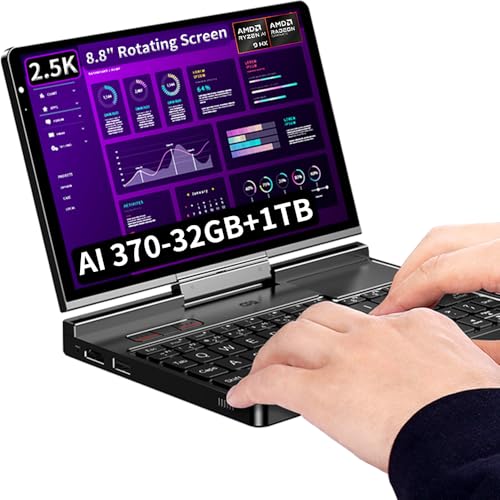
LANRUO GPD Pocket 4 8.8" 144Hz
Best for: portable productivity and high-res gaming
- Processor
- AMD Ryzen A1 9 HX-370
- RAM
- 32GB
- Storage
- 1TB
- Screen Size
- 8.8"
- Refresh Rate
- 144Hz
- Display Type
- LTPS
View on Amazon: LANRUO GPD Pocket 4 8.8" 144Hz Affiliate link
The GPD Pocket 4 is an 8.8-inch handheld PC with a rotating screen. It uses an AMD Ryzen AI 370 processor with 12 cores and 24 threads. The display offers 2560x1600 resolution at 144Hz. You get 32GB of RAM and 1TB of storage. This setup supports demanding tasks and smooth visuals. It suits users who need a compact, modular device with strong performance.
Pros
- AMD Ryzen AI 370 CPU with up to 5.1 GHz turbo
- 8.8-inch 144Hz LTPS display with 2560x1600 resolution
- 32GB RAM and 1TB storage capacity
- Modular I/O ports including optional LTE and KVM
Cons
- 725 grams weight adds bulk for handheld use
- 44.8Wh battery limits heavy use to about 2 hours
- Modular ports are not included in standard configuration
Good fit if
- You need a high-refresh-rate screen in a small form factor
- You require extensive connectivity options via modular ports
- You want strong multi-core performance for productivity
Skip if
- You prioritize maximum battery life for long trips
- You need a lightweight device for one-handed play
- You want all connectivity ports included by default
Verdict: GPD Pocket 4 Ryzen AI 370 8.8" Handheld fits professionals who need a powerful, portable workstation with a high-quality screen and flexible connectivity.

MSI Claw A1M 7" 1080p Handheld
Best for: portable gaming with a high-refresh screen
- Processor
- Intel Ultra 5-135H
- RAM
- 16GB LPDDR5
- Storage
- 512GB PCIe NVMe SSD
- Screen Size
- 7"
- Refresh Rate
- 120Hz
- Display Type
- IPS
View on Amazon: MSI Claw A1M 7" 1080p Handheld Affiliate link
The MSI Claw A1M-052US is a compact 7-inch gaming laptop with an FHD 120Hz touchscreen. It uses a 14th Gen Ultra 5-135H processor and Intel Arc graphics. You get 16GB of onboard RAM and 512GB of storage. This device suits players who want portability without sacrificing screen clarity. The Thunderbolt 4 port and Micro SD reader add connectivity options for your peripherals.
Pros
- 7-inch 120Hz FHD IPS touchscreen display
- 14th Gen Ultra 5-135H processor with 14 cores
- 16GB onboard RAM and 512GB PCIe NVMe SSD
- Thunderbolt 4 and Micro SD reader support
Cons
- 1.44-pound weight may feel heavy for one-handed play
- 53 Whr battery limits unplugged gaming sessions
- Onboard RAM cannot be upgraded later
Good fit if
- You prioritize a high-refresh-rate screen in a small form factor
- You need Thunderbolt 4 for fast data transfer
- You want a lightweight device for travel
Skip if
- You require a large screen for immersive gaming
- You need to upgrade RAM or storage later
- You want a device with a longer warranty period
Verdict: MSI Claw A1M 7" Gaming Laptop delivers sharp visuals and solid processing power in a portable package. It fits gamers who value screen quality and connectivity over raw expandability.
Specifications side by side
| Spec | LANRUO GPD Pocket 4 8.8" 144Hz | MSI Claw A1M 7" 1080p Handheld |
|---|---|---|
| Processor | AMD Ryzen A1 9 HX-370 | Intel Ultra 5-135H |
| RAM | 32GB | 16GB LPDDR5 |
| Storage | 1TB | 512GB PCIe NVMe SSD |
| Screen Size | 8.8" | 7" |
| Refresh Rate | 144Hz | 120Hz |
| Display Type | LTPS | IPS |
| Resolution | 2560x1600 | 1920x1080 |
| Graphics | AMD Radeon 890M RNDA3 | Intel Arc Integrated Graphics |
| Operating System | Win 11 Home | Windows 11 Home |
| Storage Capacity | 1TB | 512GB |
| Screen Resolution | QHD | 1080p |
| Color | Black | Black |
| Memory | 32GB | 16GB |
| Platform | PC | not stated |
| Dimensions | 8.14 × 0.87 × 2.91 inches | 4.6 × 11.6 × 0.83 inches |
| Weight | 725 grams | 1.44 pounds |
| Size | AI 370-32GB+1TB | not stated |
| Model | GPD Pocket 4 | Claw A1M-052US |
Frequently asked questions
Which handheld offers a higher screen resolution between MSI and LANRUO?
LANRUO provides the higher resolution with its QHD panel on the GPD Pocket 4. The MSI Claw A1M features a 1080p display instead. If you want more screen real estate and sharper visuals on an 8.8-inch surface, the LANRUO handheld gives you greater pixel density than the 7-inch MSI screen.
Does the MSI Claw or LANRUO GPD Pocket 4 have a touchscreen?
The MSI Claw A1M explicitly specifies a touchscreen display. Its 7-inch 1080p screen supports direct touch input for navigation and gaming. In contrast, the published hardware specifications for the LANRUO GPD Pocket 4 focus on its 8.8-inch QHD resolution without listing touchscreen hardware in the official configuration data.
How do the display refresh rates compare between these two devices?
The LANRUO GPD Pocket 4 delivers a faster refresh rate of 144Hz, whereas the MSI Claw A1M tops out at 120Hz. Both refresh rates ensure fluid on-screen motion during fast-paced play. You benefit from a slightly smoother visual output on the LANRUO unit, paired with its larger 8.8-inch panel.
Which device is lighter to carry, the MSI Claw or LANRUO GPD Pocket 4?
The MSI Claw A1M is lighter, weighing 1.44 pounds. In comparison, the LANRUO GPD Pocket 4 lists a total weight of 725 grams. If you prioritize a lighter build for handheld play, the MSI model places less mass in your hands during extended gaming periods.
How do the physical dimensions of the MSI Claw and LANRUO GPD Pocket 4 compare?
The LANRUO GPD Pocket 4 has a more compact length of 8.14 inches, with a width of 0.87 inches and height of 2.91 inches. The MSI Claw measures 11.6 inches wide, 4.6 inches long, and 0.83 inches high. You get a significantly narrower horizontal layout with LANRUO, while MSI provides a broader handheld grip.
How much onboard storage does the LANRUO GPD Pocket 4 have?
The LANRUO GPD Pocket 4 comes equipped with 1TB of storage capacity alongside 32GB of memory. This configuration allows you to install multiple large PC titles and store local media directly on the machine. You can maintain an extensive personal game library without needing to clear space frequently for new title installations.