HTC Vive Focus Vision Wired or HTC VIVE Pro Virtual Reality? Which HTC Model to Buy
As an Amazon Associate we earn from qualifying purchases. Links on this page are affiliate links.
When evaluating the htc vive focus vision wired vs vive pro virtual reality systems, you find two distinct hardware designs for PC VR immersion. Both units share black chassis designs and integrated 3D spatial audio setups. The main difference lies in their tracking and display setups. The Vive Pro uses external SteamVR 2.0 tracking with Dual-OLED displays, while the Focus Vision features base-station-free tracking and 5K resolution.
Key differences
| Aspect | HTC Vive Pro Full VR System | HTC Vive Focus Vision Wired XR Headset |
|---|---|---|
| Screen resolution | 2880 x 1600 pixels | 2448 x 2448 pixels per eye |
| Display type | Dual-OLED | not listed |
| Refresh rate | not listed | 90 Hz |
| Tracking method | SteamVR 2.0 external tracking | Base station-free tracking |
| IPD adjustment | Manual IPD adjustment | Auto-IPD adjustment |
| Weight | 3.82 pounds | 5.5 pounds |
Which one should you choose?
Choose HTC Vive Pro Full VR System if
- You want Dual-OLED displays for deep black levels and visual clarity.
- You prefer sub-millimeter SteamVR 2.0 tracking with base stations.
- You prioritize a lighter hardware weight of 3.82 pounds.
Choose HTC Vive Focus Vision Wired XR Headset if
- You want 2448 x 2448 per-eye resolution with a 90 Hz refresh rate.
- You prefer base-station-free operation with integrated eye and hand tracking.
- You need hot-swappable battery support for continuous session use.
Verdict: The Vive Pro suits users who rely on SteamVR 2.0 base station tracking and Dual-OLED panels in a lighter package. The Vive Focus Vision fits users who prioritize higher per-eye resolution, automated IPD calibration, and base-station-free sensors. Your choice depends on whether you prefer an external tracking environment or built-in optical tracking.
HTC Vive Focus Vision vs Vive Pro
Screen resolution and refresh rate
Display resolution defines graphical clarity and detail inside virtual simulations. The HTC VIVE Pro Virtual Reality Full System features dual screens with a combined resolution of 2880 x 1600 pixels, though its refresh rate and field of view are not stated in the provided specifications. The HTC Vive Focus Vision Wired XR Headset provides a higher 5K resolution configuration, generating 2448 x 2448 pixels per eye. The Focus Vision also specifies a 90 Hz refresh rate and a field of view reaching up to 120 degrees. For overall panel sharpness and wider visual coverage, the Vive Focus Vision holds the advantage.
Display type
Panel technology influences contrast levels and color depth during immersion. The HTC VIVE Pro Virtual Reality Full System relies on Dual-OLED displays, which provide deep black levels and visual fidelity for virtual graphics, text, and environmental textures. In comparison, the HTC Vive Focus Vision Wired XR Headset lists its screen as an immersive 5K headset display, but the specifications do not state whether it uses OLED, LCD, or alternative panel hardware. While the Focus Vision targets high resolution, the Vive Pro explicitly confirms Dual-OLED engineering. You get guaranteed OLED panel technology when choosing the Vive Pro.
Tracking sensors and room scale
Tracking architecture dictates your movement freedom and interaction capabilities. The HTC VIVE Pro Virtual Reality Full System utilizes external SteamVR 2.0 tracking. This hardware tracks areas from seated positions up to a 22-foot-11-inch by 22-foot-11-inch room scale with sub-millimeter accuracy, and it supports the Vive Tracker ecosystem. On the other hand, the HTC Vive Focus Vision Wired XR Headset eliminates base stations entirely. It integrates onboard eye tracking, low-light hand tracking, and a depth sensor for physical scene understanding. It also supports face and body trackers. You gain more integrated sensor capabilities with the base station-free Focus Vision.
Everyday use and IPD adjustment
Adjusting a headset properly ensures clear focus and comfortable daily wear. The HTC VIVE Pro Virtual Reality Full System includes adjustments for head size, glasses accommodation, and interpupillary distance (IPD) to fit different users. The HTC Vive Focus Vision Wired XR Headset upgrades this setup with automatic IPD adjustment, which aligns the lenses directly with the centers of your pupils. The Focus Vision also features a hot-swappable battery system supported by a reserve front battery to maintain power during swaps. You receive a more automated adjustment process and uninterrupted power options on the Focus Vision.
Build dimensions and weight
Headset mass and proportions determine physical neck strain during long gaming sessions. The HTC VIVE Pro Virtual Reality Full System weighs 3.82 pounds and measures 4 inches wide, 8 inches high, and 2 inches long. Its design emphasizes balanced weight distribution across your head. The HTC Vive Focus Vision Wired XR Headset is heavier and bulkier, weighing 5.5 pounds while measuring 14.6 inches wide, 4.9 inches high, and 13.3 inches long. That makes the Vive Pro significantly lighter to support during play. You get a much lower hardware weight with the Vive Pro system.
Audio setup and noise handling
Immersive sound requires both high-grade drivers and isolation from surrounding household noise. The HTC VIVE Pro Virtual Reality Full System features integrated hi-res, high-impedance headphones that produce 3D spatial sound alongside active noise cancellation to block outside room sounds. The HTC Vive Focus Vision Wired XR Headset employs open-back, dual-driver speakers designed to reduce sound leakage, paired with noise- and echo-cancelling microphones and a 3.5 mm audio jack. The Vive Pro isolates you more effectively thanks to its high-impedance drivers and active noise cancellation technology. You get dedicated headphone isolation on the Vive Pro.
Choosing Your HTC VR System
Users needing expansive sub-millimeter room-scale tracking
You get SteamVR 2.0 tracking covering up to 22’11” by 22’11” spaces with sub-millimeter accuracy. The package includes built-in headphones with active noise cancellation and native support for the Vive Tracker ecosystem. It also has a lighter hardware weight at 3.82 pounds.
Players wanting integrated eye tracking without base stations
You get an all-in-one design that operates without external base stations. The headset features integrated eye tracking, low-light hand tracking, and auto-IPD adjustment. Its display offers a 120-degree field of view with a 90 Hz refresh rate, plus DisplayPort mode for wired PC streaming.
Users prioritizing mixed reality depth sensing and continuous power
This model features a built-in depth sensor for mixed reality scene understanding. You also get a hot-swappable battery system backed by a reserve front battery, allowing battery changes without powering off. Audio hardware includes open-back dual-driver speakers, noise-cancelling microphones, and a 3.5 mm jack.
The products compared

HTC Vive Pro Full VR System
Best for: high-resolution VR simulations and multi-user environments
- Display Resolution
- 2880 x 1600
- Display Type
- OLED
- Color
- Black
- Dimensions
- 2 × 4 × 8 inches
- Weight
- 3.82 pounds
View on Amazon: HTC Vive Pro Full VR System Affiliate link
The HTC Vive Pro delivers high-resolution visuals with dual-OLED displays at 2880 x 1600 pixels. It features Steam VR 2.0 tracking for room-scale movement up to 22’11” x 22’11”. The system includes spatial audio with noise cancellation and a VIVE Tracker ecosystem for business simulations. Weighing 3.82 pounds, it offers adjustable IPD and head size settings for extended use.
Pros
- Dual-OLED displays with 2880 x 1600 pixel resolution
- Steam VR 2.0 tracking for sub-millimeter accuracy
- Spatial audio with active noise cancellation
- VIVE Tracker ecosystem for object simulation
Cons
- Heavy 3.82 pounds build
- Large 8 x 4 x 2 inch form factor
- No mention of wireless connectivity
Good fit if
- You need high-resolution visual fidelity for text and graphics
- You require room-scale tracking for standing experiences
- You want to expand use cases with VIVE Trackers
Skip if
- You prefer lightweight headsets under 3 pounds
- You need a wireless standalone experience
- You only want seated VR experiences
Verdict: HTC Vive Pro VR System offers superior visual clarity and precise tracking for users who prioritize immersion and simulation accuracy over portability.
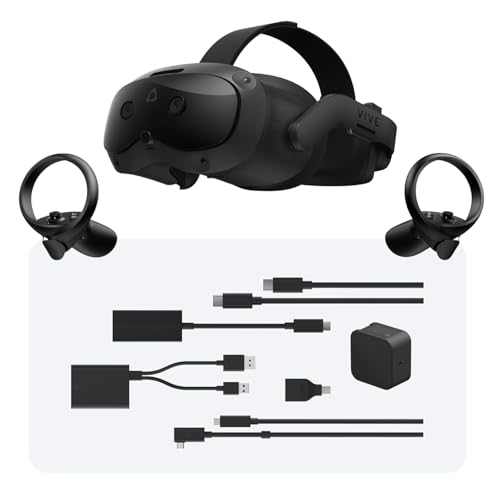
HTC Vive Focus Vision Wired XR Headset
Best for: High-fidelity PC VR with natural tracking
- Display Resolution
- 2448 x 2448 pixels per eye
- Refresh Rate
- 90 Hz
- Field of View
- 120°
- Connectivity
- DisplayPort
- Tracking Type
- Inside-Out
- Color
- Black
View on Amazon: HTC Vive Focus Vision Wired XR Headset Affiliate link
This standalone XR headset delivers 5K resolution displays with 2448 x 2448 pixels per eye and a 90 Hz refresh rate. It supports PC VR via DisplayPort and includes built-in eye, hand, and face tracking. The hot-swappable battery allows for extended play sessions. It suits users seeking high-fidelity visuals and natural interaction without base stations.
Pros
- 5K resolution displays with 2448 x 2448 pixels per eye
- Built-in eye, hand, and face tracking support
- Hot-swappable battery for uninterrupted gaming
- Auto-IPD adjustment for clear viewing
Cons
- Heavier build at 5.5 pounds
- Requires DisplayPort connection for PC VR streaming
- No mention of Bluetooth connectivity
Good fit if
- You want high-resolution visuals with 5K displays
- You need natural hand and face tracking
- You prefer base station-free tracking
Skip if
- You need a lightweight headset under 5 pounds
- You require wireless PC VR streaming
- You want built-in Bluetooth for audio
Verdict: HTC Vive Focus Vision Wired Bundle offers high-resolution 5K displays and natural tracking for immersive PC VR experiences. It is ideal for users prioritizing visual fidelity and interaction over lightweight design.
Specifications side by side
| Spec | HTC Vive Pro Full VR System | HTC Vive Focus Vision Wired XR Headset |
|---|---|---|
| Display Resolution | 2880 x 1600 | 2448 x 2448 pixels per eye |
| Refresh Rate | not stated | 90 Hz |
| Field of View | not stated | 120° |
| Display Type | OLED | not stated |
| Connectivity | not stated | DisplayPort |
| Tracking Type | not stated | Inside-Out |
| Color | Black | Black |
| Platform | not stated | PC |
| Use | not stated | Streaming |
| Dimensions | 2 × 4 × 8 inches | 13.3 × 14.6 × 4.9 inches |
| Weight | 3.82 pounds | 5.5 pounds |
| Model | 99HANW001-00 | VIVE Focus Vision |
| Size | not stated | Standard |
Frequently asked questions
Which headset weighs less between these two HTC models?
The HTC Vive Pro Full VR System is significantly lighter. It weighs 3.82 pounds according to official hardware measurements. In comparison, the HTC Vive Focus Vision Wired model weighs 5.5 pounds. If you plan for extended sessions where physical weight matters, the lighter 3.82-pound Vive Pro reduces total bulk.
What display resolution does the HTC Vive Focus Vision Wired offer?
The HTC Vive Focus Vision Wired features high-resolution 5K displays. HTC designs this headset specifically for PC platforms and streaming use. This configuration delivers high visual fidelity during desktop sessions. The hardware focuses on graphic fidelity and natural tracking rather than a lightweight footprint, making it suitable for detailed PC-based immersion.
Which HTC VR model is better for multi-user environments?
The HTC Vive Pro Full VR System is best suited for multi-user environments. HTC specifies this unit for high-resolution VR simulations and shared configurations. Its chassis balances simulation accuracy with a 3.82-pound weight. You can deploy it effectively in collaborative or multi-person setups where users prioritize visual clarity and precise simulation tracking.
What are the physical dimensions of the HTC Vive Focus Vision Wired?
The HTC Vive Focus Vision measures 14.6 inches wide, 4.9 inches high, and 13.3 inches long. This standard-size black headset weighs 5.5 pounds. The physical frame houses hardware built for wired PC streaming. You should account for these larger dimensions when planning storage space or carrying cases for your VR equipment.
Can you use the HTC Vive Focus Vision Wired for streaming on PC?
Yes, the HTC Vive Focus Vision Wired is built specifically for PC VR streaming. HTC lists its platform as PC with dedicated wired connectivity. You connect the headset directly to your computer to drive its 5K visual output. This configuration ensures consistent data flow for high-fidelity PC VR and natural tracking.
How compact is the HTC Vive Pro Full VR System compared to the Focus Vision?
The HTC Vive Pro is substantially more compact than the Focus Vision. The Vive Pro measures 4 inches wide, 8 inches high, and 2 inches long, with a weight of 3.82 pounds. The Focus Vision measures 14.6 by 4.9 by 13.3 inches. The Vive Pro takes up noticeably less storage space.
What tracking type does the HTC Vive Focus Vision Wired provide?
The HTC Vive Focus Vision Wired provides natural tracking for immersive PC VR. HTC designed this headset for users prioritizing natural interaction and 5K visual fidelity. The system pairs its tracking features with wired PC connectivity to maintain direct responsiveness. You get a setup configured for detailed simulations and graphic-rich desktop streaming.