144Hz vs 90Hz Handheld Gaming PCs in 2026: Key Differences
As an Amazon Associate we earn from qualifying purchases. Links on this page are affiliate links.
Choosing a 144Hz vs 90Hz handheld gaming PC comes down to motion clarity, panel size, and hardware capacity. Both the Lenovo Legion Go 2 and the Valve Steam Deck OLED feature vivid OLED panels and Wi-Fi 6E connectivity for online play. The primary difference lies in their refresh rates and screens. The Legion Go 2 delivers 144Hz motion on an 8.8-inch display, while the Steam Deck OLED provides a 90Hz refresh rate across 7.4 inches.
Key differences
| Aspect | Lenovo Legion Go 2 Handheld Gaming PC | Valve Steam Deck OLED 512GB |
|---|---|---|
| Refresh rate | 144Hz | 90Hz |
| Screen size | 8.8 inches | 7.4 inches |
| Screen resolution | WQXGA | not listed |
| Storage capacity | 1TB | 512GB |
| Processor | AMD Ryzen Z2 | AMD APU |
Which one should you choose?
Choose Lenovo Legion Go 2 Handheld Gaming PC if
- You prioritize a faster 144Hz refresh rate paired with a larger 8.8-inch WQXGA screen.
- You need 1TB of internal SSD storage and a 74Whr battery capacity.
Choose Valve Steam Deck OLED 512GB if
- You prefer a more compact 7.4-inch HDR OLED display running at 90Hz.
- You want built-in trackpads for precision control in your games.
Verdict: The Lenovo Legion Go 2 suits you if you want a larger 144Hz screen with higher storage capacity. The Valve Steam Deck OLED fits you if you want a lighter, 90Hz HDR display with integrated trackpads. Your decision comes down to panel dimensions and your target refresh rate.
144Hz vs 90Hz Handheld PC Comparison
Refresh Rate and Motion
The Lenovo Legion Go 2 provides a 144Hz refresh rate on its 8.8-inch display, giving you faster frame delivery and smoother motion in action scenes. In comparison, the Valve Steam Deck OLED tops out at a 90Hz refresh rate across its 7.4-inch screen. While 90Hz offers a clear upgrade over standard 60Hz panels, 144Hz allows higher peak frame rates when hardware pushes beyond 90 frames per second. Lenovo pairs this speed with a WQXGA resolution, whereas Valve focuses on 90Hz motion rendition. If your priority is maximum refresh frequency and fluid visual updates, the Legion Go 2 holds the clear technical advantage.
Internal Storage Capacity
Storage limits dictate how many large installations you can keep ready at once. The Lenovo Legion Go 2 includes a 1TB PCIe SSD, giving you ample room for modern game installs and system files. The Valve Steam Deck OLED comes equipped with a 512GB SSD. Because many current PC titles easily exceed 100GB, the 512GB drive fills up rapidly after just a few large installations. Lenovo gives you double the capacity right out of the box, reducing the immediate need to swap files or rely on external expansion cards. For raw internal capacity, the Legion Go 2 wins.
Display HDR Capability
Visual contrast depends heavily on display standards. The Valve Steam Deck OLED features an HDR OLED panel engineered for pure blacks and expanded dynamic range. High dynamic range support allows compatible titles to show higher contrast ratios, richer highlights, and deep shadows directly on its 7.4-inch screen. The Lenovo Legion Go 2 features an 8.8-inch WQXGA PureSight OLED panel with vivid colors and fast response rates, but the provided specifications do not list HDR support. Because the Steam Deck OLED provides dedicated HDR hardware certification in its panel specs, it takes the lead for high dynamic range fidelity.
Processor and System Memory
Computing performance depends on the internal chipset and system memory. The Lenovo Legion Go 2 features an AMD Ryzen Z2 processor, AMD Radeon graphics, and 16GB of system RAM to handle demanding workloads. The Valve Steam Deck OLED runs on an updated AMD APU designed for energy efficiency and AAA title performance. However, the Steam Deck data does not list specific memory amounts, clock frequencies, or GPU core counts. Because Lenovo provides explicit hardware specifications with a modern Ryzen Z2 chip and a verified 16GB memory footprint, it offers greater confirmed processing capability on paper.
Built-In Trackpad Controls
Control inputs shape your navigation across desktop interfaces and strategy games. The Valve Steam Deck OLED incorporates built-in trackpads alongside an improved touchscreen with enhanced haptics, giving you mouse-like cursor accuracy without detaching hardware. The Lenovo Legion Go 2 takes a different route with its Legion Truestrike controllers. Its right controller detaches to function as a vertical mouse in FPS mode. While Lenovo offers unique physical flexibility for shooters, the Steam Deck integrates dual trackpads directly into the primary handheld chassis for immediate strategy and cursor control. For self-contained trackpad input, the Steam Deck takes the advantage.
Choosing Your Handheld Gaming PC
First-person shooter fans wanting mouse input
You get detachable Truestrike controllers that switch to FPS mouse mode for aiming accuracy. Its 1TB PCIe SSD holds large installations, while the 16GB memory supports intense titles. The 74Whr battery powers long portable sessions alongside dual 2W speakers with Nahimic Audio.
Strategy players wanting built-in trackpads
You get built-in trackpads alongside an improved touchscreen with haptics for precision inputs in strategy titles. Its 7.4-inch HDR OLED display presents vivid colors with deep blacks. A power-efficient AMD APU keeps demands balanced, while Wi-Fi 6E provides fast download speeds across your library.
Players prioritizing high resolution and battery capacity
You receive a sharp WQXGA resolution on an 8.8-inch OLED panel powered by the AMD Ryzen Z2 processor. A 74Whr battery offers dedicated capacity for mobile sessions, while the Coldfront thermal system uses dual heat pipes and larger fan radiators to manage internal heat.
Quick picks
| # | Product | Best for | Price |
|---|---|---|---|
| 1 | Lenovo Legion Go 2 Handheld Gaming PC | high-fidelity OLED handheld gaming | Check price of Lenovo Legion Go 2 Handheld Gaming PC on Amazon |
| 2 | Valve Steam Deck OLED 512GB | OLED visuals and balanced 90Hz portable gaming | Check price of Valve Steam Deck OLED 512GB on Amazon |
The products compared
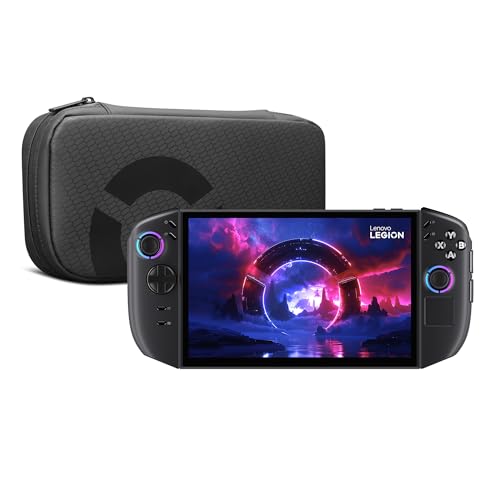
Lenovo Legion Go 2 Handheld Gaming PC
Best for: high-fidelity OLED handheld gaming
- Refresh Rate
- 144Hz (what this guide is about)
- Processor
- AMD Ryzen Z2
- RAM
- 16GB
- Storage
- 1TB
- Screen Size
- 8.8"
- Display Type
- OLED
View on Amazon: Lenovo Legion Go 2 Handheld Gaming PC Affiliate link
The Lenovo Legion Go 2 is a mobile gaming console featuring an AMD Ryzen Z2 processor and an 8.8-inch WQXGA OLED display. It includes 16GB of RAM and a 1TB PCIe SSD for fast performance. The device supports 144Hz refresh rates and offers a 74Whr battery for extended play. It connects via Wi-Fi 6E and Bluetooth 5.3. This system suits players who want high-resolution visuals and detachable controllers for versatile gaming.
Pros
- 8.8-inch WQXGA OLED display with 144Hz refresh rate
- AMD Ryzen Z2 processor and 16GB RAM
- 1TB PCIe SSD storage capacity
- Detachable Truestrike controllers with mouse mode
- 74Whr battery for extended unplugged sessions
Cons
- 2.02 pounds weight is substantial for handheld use
- 11.7 inches length may reduce portability
- Integrated dual 2W speakers lack bass depth
Good fit if
- You prioritize high-resolution OLED visuals and fast refresh rates
- You want detachable controllers for mouse-like aiming in FPS games
- You need ample storage for large game libraries
Skip if
- You prefer a lighter device for extended carrying
- You require integrated controllers for maximum compactness
- You are sensitive to device weight during long sessions
Verdict: Lenovo Legion Go 2 8.8" OLED delivers high-end specs with its OLED panel and Ryzen Z2 chip. It fits gamers who value visual fidelity and versatile controller configurations over ultra-portability.

Valve Steam Deck OLED 512GB
Best for: OLED visuals and balanced 90Hz portable gaming
- Refresh Rate
- 90Hz (what this guide is about)
- Storage
- 512GB SSD
- Screen Size
- 7.4"
- Display Type
- HDR OLED
- Color
- Black
- Size
- 2TB
View on Amazon: Valve Steam Deck OLED 512GB Affiliate link
This handheld gaming PC features a 7.4-inch HDR OLED display with a 90Hz refresh rate. It runs on an updated AMD APU and includes 512GB of SSD storage alongside Wi-Fi 6E connectivity. If you want fluid 90Hz visuals with deep OLED contrast and built-in trackpad controls for your Steam library, this hardware provides balanced portable performance.
Pros
- 7.4-inch HDR OLED display with pure black levels
- 90Hz refresh rate for smooth on-screen motion
- Wi-Fi 6E connectivity for low-latency downloads
- Built-in trackpads and responsive touchscreen input
Cons
- 90Hz refresh rate is lower than 144Hz alternatives
- Factory seal is opened to install the 512GB SSD upgrade
- 7.4-inch screen provides less display area than 8.8-inch formats
Good fit if
- You prioritize HDR OLED contrast and 90Hz motion over ultra-high refresh rates.
- You want physical trackpads and dedicated Bluetooth antenna connectivity.
- You need Wi-Fi 6E for rapid library installations.
Skip if
- You require a 144Hz refresh rate for high-frame-rate competitive titles.
- You prefer a larger 8.8-inch display panel.
- You want a device with an untouched factory packaging seal.
Verdict: Valve Steam Deck OLED 90Hz Handheld fits players who prioritize deep OLED contrast, physical trackpads, and efficient 90Hz gaming on the go.
Specifications side by side
| Spec | Lenovo Legion Go 2 Handheld Gaming PC | Valve Steam Deck OLED 512GB |
|---|---|---|
| Processor | AMD Ryzen Z2 | not stated |
| RAM | 16GB | not stated |
| Storage | 1TB | 512GB SSD |
| Screen Size | 8.8" | 7.4" |
| Refresh Rate | 144Hz | 90Hz |
| Display Type | OLED | HDR OLED |
| Resolution | WQXGA | not stated |
| Graphics | AMD Radeon Graphics | not stated |
| Storage Capacity | 1TB | 512GB |
| Screen Resolution | WQXGA | not stated |
| Color | Black | Black |
| Size | not stated | 2TB |
| Graphics Card | AMD Radeon | not stated |
| Memory | 16GB | not stated |
| Platform | Mobile | PC |
| Dimensions | 11.7 × 5.39 × 1.65 inches | not stated |
| Weight | 2.02 pounds | not stated |
| Model | 83N10009US | not stated |
Frequently asked questions
What is the main visual benefit of a 144Hz display over 90Hz on a handheld?
A 144Hz screen updates rendered images up to 144 times every second, creating noticeably fluid transitions compared to 90Hz. On the Lenovo Legion Go 2, this higher refresh rate pairs with an 8.8-inch WQXGA OLED panel, displaying faster frame updates during fast gameplay.
Does a 90Hz OLED handheld screen still feel fluid for modern games?
Yes, 90Hz provides a clear step up from standard 60Hz displays. It refreshes frames every 11.1 milliseconds. The Valve Steam Deck OLED uses this 90Hz standard on its 7.4-inch OLED panel, giving you smooth motion delivery and balanced performance for portable PC sessions.
Which processor powers the 144Hz Lenovo Legion Go 2?
The Lenovo Legion Go 2 runs on an AMD Ryzen Z2 processor paired with AMD Radeon graphics. This mobile platform features 16GB RAM and a 1TB internal drive, giving you dedicated compute hardware designed to drive high-resolution WQXGA visuals on its 144Hz OLED screen.
How do the screen sizes differ between these 144Hz and 90Hz handhelds?
Display sizes vary significantly across these 2 devices. The 144Hz Lenovo Legion Go 2 carries an 8.8-inch display, offering a wider viewing surface. In contrast, the 90Hz Valve Steam Deck OLED uses a smaller 7.4-inch panel, keeping the overall form factor more compact.
Can you store large game libraries on these handheld gaming PCs?
Yes, both systems provide ample space for installations. The 144Hz Lenovo Legion Go 2 includes a 1TB storage drive straight out of the box. The 90Hz Valve Steam Deck OLED lists a 512GB base capacity, with hardware configurations scaling up to 2TB for your games.
How heavy is an 8.8-inch 144Hz handheld compared to smaller options?
Larger screen sizes add physical bulk to the hardware. The 8.8-inch Lenovo Legion Go 2 weighs 2.02 pounds, with dimensions measuring 11.7 inches long, 5.39 inches wide, and 1.65 inches high. Smaller 90Hz units typically offer lighter profiles due to their reduced footprints.